


Dr. Bhupendra Kumar Sullere
"Water, forests, and land are not merely natural resources; they are the very soul of tribal life, culture, and identity. When these were threatened, history witnessed the 'Hul'—a revolutionary movement that shook the foundations of British colonial rule."
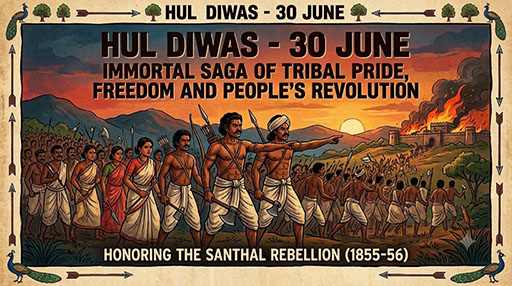
India's struggle for independence did not begin only with the Revolt of 1857. Long before that, several regions of the country witnessed powerful movements against colonial exploitation and injustice. Among the most significant of these was the Santhal Hul (Santhal Rebellion), which began on 30 June 1855 from Bhognadih village in present-day Jharkhand under the leadership of the legendary tribal heroes Sidho Murmu and Kanhu Murmu.
To commemorate this historic uprising, 30 June is observed every year as Hul Diwas. The day is not merely a remembrance for the tribal community but a national tribute to the spirit of freedom, justice, dignity, and resistance against oppression. It honors the courage and sacrifice of thousands of tribal men and women who fought fearlessly against British colonialism, exploitative landlords, and moneylenders to protect their land, culture, and identity.
The word "Hul" in the Santhali language means revolution, uprising, or a collective movement against injustice. It symbolized the determination of the Santhal people to defend their rights, preserve their way of life, and reject foreign domination. Hul was not merely a rebellion; it was a declaration that dignity and freedom were worth every sacrifice.
The Background of Oppression
During British rule, the Santhal community faced severe economic and social exploitation. The colonial administration introduced oppressive land revenue systems that disrupted the traditional lifestyle of tribal communities. Moneylenders and zamindars, supported by the British authorities, trapped tribal families in cycles of debt, confiscated their lands, imposed excessive taxes, and forced many into bonded labor.
The forests, which had sustained tribal life for generations, came under colonial control. Traditional rights over land and natural resources were taken away, while administrative corruption and exploitation became widespread. The continuous injustice pushed the Santhals to the brink, leaving resistance as their only option.
Sidho and Kanhu: The Architects of the Revolution
At this critical juncture emerged two extraordinary leaders—Sidho Murmu and Kanhu Murmu. They were joined by their brothers Chand Murmu and Bhairav Murmu, and the courageous sisters Phulo Murmu and Jhano Murmu, who became symbols of tribal resistance.
On 30 June 1855, nearly ten thousand Santhals assembled at Bhognadih. There, Sidho and Kanhu declared that British authority would no longer be accepted. They called upon their people to unite in defense of their rights, freedom, and dignity. Their call ignited a mass movement that rapidly spread across hundreds of villages.
One of India's Earliest Freedom Movements
The Santhal Hul stands as one of the earliest large-scale organized revolts against British rule, occurring two years before the Revolt of 1857. It demonstrated that the desire for freedom was deeply rooted not only among urban populations but also among India's tribal communities.
Despite possessing only traditional weapons such as bows, arrows, axes, and spears, the Santhal warriors displayed extraordinary courage against the British army, equipped with modern firearms and military resources. Their determination proved that true strength lies not merely in weapons but in conviction, unity, and the spirit of freedom.
Brutal Suppression and Supreme Sacrifice
Alarmed by the scale of the uprising, the British launched a ruthless military campaign. Villages were burned, thousands of innocent tribal men, women, and children were killed, and countless others were imprisoned.
Sidho and Kanhu were eventually captured and executed. Chand, Bhairav, Phulo, Jhano, and thousands of unnamed tribal heroes also laid down their lives for the cause of justice and freedom. Although the British succeeded in crushing the rebellion militarily, they could never extinguish the spirit of resistance that Hul had ignited.
Contribution to India's Freedom Struggle
The Santhal Hul occupies a distinguished place in India's freedom movement. It inspired subsequent tribal uprisings, including Birsa Munda's Ulgulan, as well as other indigenous resistance movements across the country. It established that India's struggle for independence was not confined to cities or royal courts but was equally sustained by the courage and sacrifices of tribal communities living in forests and remote regions.
Hul and Environmental Consciousness
The Hul movement also reflected the deep relationship between tribal communities and nature. For the Santhals, forests, rivers, and land were not commodities but sacred foundations of life, culture, and identity.
In today's world, where environmental conservation has become a global priority, the values embodied by Hul—respect for nature, sustainable living, and community-based stewardship of natural resources—remain profoundly relevant.
Lessons for the Younger Generation
Hul Diwas offers timeless lessons for today's youth. It teaches that freedom demands courage, justice requires collective action, and cultural heritage must be preserved with pride. The lives of Sidho and Kanhu remind us that even those with limited resources can challenge powerful systems through unity, determination, and moral conviction.
Young people should draw inspiration from their unwavering commitment to justice, their respect for nature, and their willingness to sacrifice everything for the welfare of society and the nation.
Contemporary Relevance
As India increasingly recognizes the invaluable contributions of its tribal communities, Hul Diwas reminds us that the nation's history remains incomplete without acknowledging the sacrifices made by indigenous freedom fighters. Educational institutions, researchers, and policymakers should continue to document and celebrate these contributions so that future generations understand the true breadth of India's struggle for independence.
Hul Diwas is far more than a historical commemoration—it is a living symbol of courage, dignity, and resistance against injustice. The sacrifices of Sidho Murmu, Kanhu Murmu, Chand Murmu, Bhairav Murmu, Phulo Murmu, Jhano Murmu, and thousands of other tribal martyrs form an inseparable part of India's national heritage.
On this Hul Diwas, let us pay our heartfelt tribute to these immortal heroes and reaffirm our commitment to justice, equality, environmental stewardship, cultural preservation, and national unity.
"Hul is not merely a chapter of history; it is an eternal flame of freedom that continues to inspire every generation to stand against injustice, protect nature, and uphold the dignity of humanity."

