


By Dr. Bhupendra Kumar Sullere
The Son of the Soil Who Turned Governance into Service
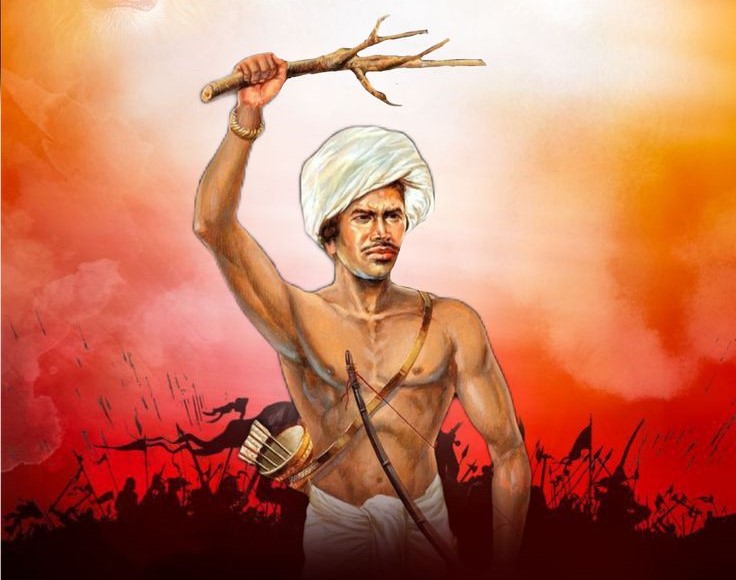
The saga of India’s freedom struggle was not confined to battlefields and political centers; it echoed through the forests and hills as well. One such voice rose from the Chotanagpur region of present-day Jharkhand — Bhagwan Birsa Munda (1875–1900) — who ignited the flame of administrative, social, and cultural consciousness among the tribal communities.
He was not merely a rebel, but a proponent of administrative justice, social equality, and cultural identity. The tribals lovingly called him “Dharti Aaba”, meaning Father of the Earth, who sowed the seeds of Swaraj (self-rule) in the hearts of the people.
The People’s Struggle Against Colonial Injustice
In the latter half of the 19th century, British rule destroyed the traditional Khuntkatti land system of the Munda community. Through the nexus of colonial officers and moneylenders, the tribals were dispossessed of their ancestral lands.
Birsa realized that this was not merely an economic issue but a question of existence and rights.
He proclaimed:
“The earth is our mother; she cannot be sold.”
This was not a mere slogan — it was the manifesto of administrative Swaraj, where governance was centered on the people, not on rulers.
‘Ulgulan’: The Spark of Swaraj
The Ulgulan (Great Rebellion) of 1899–1900 led by Birsa Munda was not just an armed uprising; it was a movement for self-respect and self-governance.
Mobilizing the people, Birsa declared:
“The time has come to awaken — to protect our land and our gods.”
This revolt shook the very foundations of British administration in the region. Eventually, Birsa was captured and imprisoned in Ranchi Jail, where he died on June 9, 1900, at the age of only 25.
Yet his ideas remain alive in the soul of India’s governance and society.
Birsa’s Administrative Philosophy: Service as Governance
Birsa’s leadership was not limited to rebellion; it rested on collective decision-making and social justice.
His administrative philosophy was guided by three fundamental principles:
1. Consensus-based decision-making (Lok Nirnay)
2.Community-centered justice (Jan Nyay)
3. Collective ownership of natural resources (Participatory Management)
He established the village assembly (Gram Sabha) as the primary unit of governance, where decisions were taken through public consent.
This model later became the philosophical foundation of India’s Panchayati Raj system.
Cultural Swaraj: Resistance Against Religious Conversion
Birsa’s movement was as much against the British political oppression as against the missionary attempts of religious conversion.
He saw conversion as a threat to the spiritual and cultural fabric of his people.
He asserted:
“Our religion is rooted in the forest, rivers, hills, and the earth. To abandon them is to abandon our God.”
This declaration linked tribal identity with cultural self-consciousness.
He organized his faith under the ‘Birsait’ religion, which was not merely a form of worship but a declaration of existence and identity.
Tribal Vision in Administration: Relevance Today
The Indian Constitution today accords special administrative provisions to tribal communities —
Article 244, the Fifth and Sixth Schedules, and the concept of Scheduled and Autonomous Tribal Areas — all these derive their moral and historical roots from the struggles of leaders like Birsa Munda.
His conviction that “governance must be based on public consent, not on coercive power” has evolved into the modern principles of decentralized governance, people’s participation, and administrative transparency.
Birsa and Contemporary Administration: Lessons and Inspiration
For modern civil servants and administrators, Birsa Munda’s life remains an inspiring lesson. He demonstrated that governance can never be meaningful unless it — Reflects the sensitivity of the people’s lives, Respects natural resources, and Places the most deprived at the center of decision-making.
Recognizing this, the Government of India in 2021 declared 15th November as ‘Janjatiya Gaurav Diwas’ (Tribal Pride Day) — a national acknowledgment that the soul of governance lies among the people.
“Dharti Aaba’s” Vision: Earth, Faith, and Dignity
Birsa Munda’s administrative philosophy can be summed up in three words:
Earth (Economy), Faith (Culture), and Dignity (Human Rights).
He envisioned a form of governance driven not merely by law, but by compassion and moral duty.
His life illuminated the eternal truth that “Power is not the purpose of governance; service is.”
The Eternal Message of Birsa Munda
As India moves towards becoming a “Developed Nation,” Birsa Munda’s message grows even more relevant.
In the race for development, administration must remember that its true purpose lies not in numbers, but in maintaining balance between humanity and nature.
“The earth is our mother; serving her is our religion.” — Bhagwan Birsa Munda
These words remain a moral compass for every administrator, policymaker, and public servant.
His vision reminds us that India’s governance will attain its true success only when it embraces the philosophy of “Dharti Aaba” — where governance means service, and administration becomes the expression of public faith.