

By Dr. Bhupendra Kumar Sullere
A Warrior Who Gave New Courage to India’s Soul
In the history of India’s freedom struggle, the name of Rani Lakshmibai is remembered not merely as a warrior queen, but as a symbol of national pride who refused to bow before foreign rule.
Her leadership, bravery, and military acumen during the Great Revolt of 1857 stand as a testimony to her extraordinary personality.
Born on 19 November 1828 as “Manu”, she possessed exceptional courage, fearlessness, and energy from childhood.
Her determination to prevent the British from capturing Jhansi was not just about political rights—it was a struggle for India’s identity, culture, and independence.
Rani Lakshmibai proved that when it comes to protecting the motherland, the distinction between man and woman becomes irrelevant—duty alone stands supreme.
Birth, Childhood, and Education: A Childhood Rooted in Culture, Courage, and Martial Art
Family Background
Birth Name: Manikarnika (Manu)
Birthplace: Varanasi
Father: Moropant Tambe
Mother: Bhagirathibai
Manu’s childhood was shaped in a deeply cultural and devotional environment. Her parents instilled in her a strong sense of self-respect, patriotism, and Indian values.
Training in Martial Arts
Raised in the royal court of the Peshwas, Manu learned horse riding, swordsmanship, archery, wrestling, and various war skills with great ease—like a child at play. Her friends affectionately called her “Chhabili”—cheerful, lively, and courageous.
Personality Development
Her life revolved around scriptures, physical training, and justice. These qualities eventually made her the beloved leader of Jhansi.
Marriage, Governance of Jhansi, and the First Conflict with the British
Rise of Rani Lakshmibai
In 1842, Manu married Maharaja Gangadhar Rao of Jhansi and became “Rani Lakshmibai.” She displayed remarkable administrative skill, compassion, and a firm sense of justice.
Crisis After the Maharaja’s Death
After the Maharaja’s death in 1853, the Rani adopted Damodar Rao as the heir to the throne. However, Lord Dalhousie invoked the “Doctrine of Lapse” and declared that Jhansi would be annexed.
The Historic Defiance
Her firm declaration reverberated across India:
“I will not give up my Jhansi.”
This was not mere resistance—
It was the birth of 19th-century Indian nationalism, which would later ignite the entire freedom movement.
The 1857 Revolt: Strategy, Organization, and Command in Battle
The First War of Independence in 1857 was the eruption of long-suppressed anger against colonial rule. Rani Lakshmibai emerged as one of its strongest pillars. Strengthening Jhansi’s Defense. She fortified the fort walls, reorganized the army, Trained soldiers in war techniques. Even women were enrolled for combat duties.
The Attack by Hugh Rose
In March 1858, the British General Hugh Rose attacked Jhansi. The Rani courageously protected her people and led the resistance from the front. The battle lasted for days and she resisted the British with fierce determination.
Leaving Jhansi
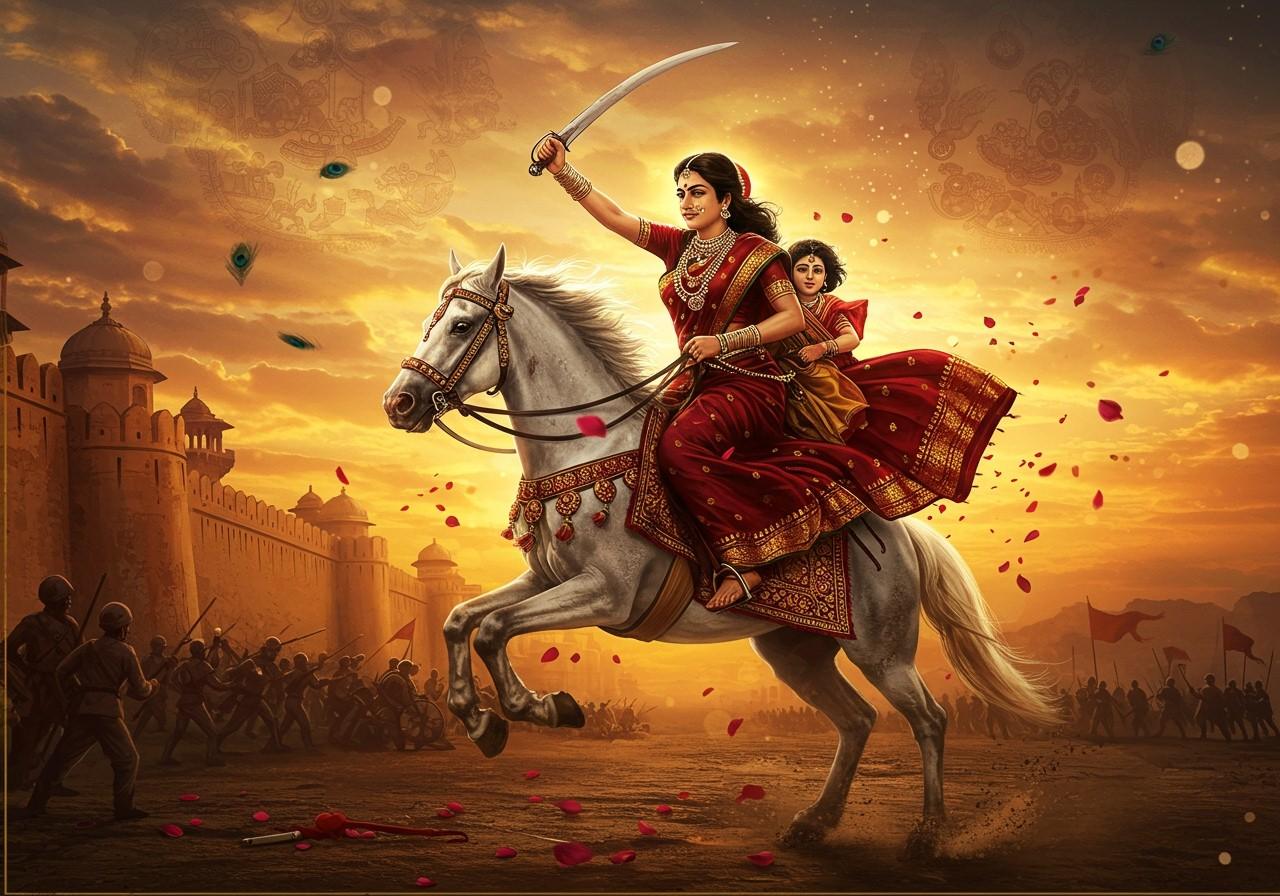
When the fort walls were shattered by heavy cannon fire, she tied her young son on her back, broke through the enemy encirclement, and rode towards Kalpi. This heroic scene became the eternal symbol of Indian womanhood.
Battles of Kalpi and Gwalior: A Sequence of Decisive Wars
Battle of Kalpi
Alongside Tatya Tope, the Rani fought a fierce battle against the British. Despite adverse circumstances, her valour stunned colonial forces.
Victory in Gwalior
Rani Lakshmibai and Tatya Tope captured Gwalior— a moment that shook the foundations of British rule. In Gwalior, she reorganized the army and prepared for the final confrontation.
The Final Battle
In June 1858, the British launched a massive attack on Gwalior. Mounted on horseback, sword in hand, Rani confronted the enemy fearlessly. Even the British soldiers were amazed at her courage.
Martyrdom: An End That Became the Beginning of Indian Nationalism
On 18 June 1858, at Kotah-ki-Serai near Gwalior, Rani Lakshmibai attained martyrdom. She did not allow herself to be captured alive—this was her vow. Even Hugh Rose, her adversary, admitted her unparalleled bravery:
“The Indian Queen was braver than any of our male soldiers.”
Impact of Her Sacrifice
Her martyrdom immortalized the Revolt of 1857. Her death kept alive the flame of freedom. Generations of revolutionaries drew inspiration from her sacrifice. A Living Icon of Indian Culture, Tradition, and Womanhood. Embodiment of Dharma and Courage.
Her life reflected the core values of Indian culture—duty, bravery, self-respect, and righteousness.
Eternal Symbol of Women Empowerment
She proved that a woman is not limited to the household— She can lead armies and defend nations. Today, India’s women soldiers, officers, and athletes continue to draw strength from her legacy.
Strengthening the Roots of Nationalism
Her struggle was not personal— It was for the protection of the nation.
Rani Lakshmibai: Another Name for Immortality
As India moves forward with renewed cultural pride and confidence, the life and sacrifice of Rani Lakshmibai becomes even more relevant.
Her message is simple:
“Let our self-respect never be compromised—that is true Indianness.”
“When the motherland is in danger, sacrifice becomes the highest duty.”
Rani Lakshmibai’s heroic saga remains a perpetual flame in India’s soul— a flame of courage, patriotism, and inspiration that will never be extinguished.