


By Gautam Sarmah
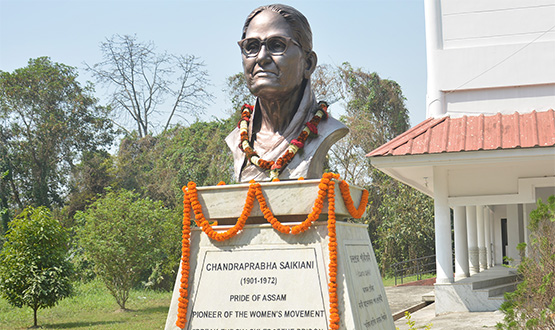
Chandraprabha Saikiani (16 March 1901 – 16 March 1972) occupies a unique and powerful place in the social and intellectual history of Assam. She was not only a freedom fighter but also a fearless social reformer who challenged deep-rooted social customs at a time when Assamese society was strongly conservative. Her life represents a rare combination of courage, intellectual independence, and moral commitment. Long before the term “women’s empowerment” became popular, she had already begun to fight for women’s rights in education, public participation, and social dignity. Because of her efforts, many historians consider her the pioneer of the feminist movement in Assam.
She was born as Chandrapriya Mazumdar in Daisingari village of present-day Bajali district in Assam. Coming from a rural background with limited opportunities for girls’ education, her early life itself became a story of determination. At that time girls’ schools were almost nonexistent in many parts of Assam. Chandraprabha and her sister Rajaniprabha walked several kilometres, often crossing muddy roads and difficult terrain, to attend a boys’ school. This simple but powerful act reflected a silent rebellion against the social restrictions imposed on girls. Her dedication impressed the school authorities and she later received a scholarship to study at the Nagaon Mission School. Even there, she did not remain silent when she saw injustice. When the school authorities refused hostel admission to a girl unless she converted to Christianity, Chandraprabha protested strongly. Her protest eventually forced the authorities to change their decision. This early incident revealed the courage and moral clarity that would define her entire life.
Education shaped Chandraprabha Saikiani’s vision, but it was her deep sense of social responsibility that transformed her into a reformer. Even while she was a student, she began teaching illiterate village girls in a small makeshift school. For her, education was not simply a personal achievement but a social mission. She clearly understood that women’s education was the key to social transformation. At a time when many families still believed that educating girls was unnecessary, her efforts helped inspire a new generation of Assamese women to pursue learning and independence.
Her association with Tezpur played an important role in shaping her public life. Tezpur in the early twentieth century was an important centre of cultural awakening in Assam. Here she came into contact with leading intellectuals and cultural figures such as Jyotiprasad Agarwala, Omeo Kumar Das, Chandranath Sharma and Lakhidhar Sarma. Their ideas about nationalism, literature, and social reform deeply influenced her thinking. In 1918, during a session of the Asom Chhatra Sanmilan held in Tezpur, Chandraprabha Saikiani addressed a large gathering and spoke against the harmful effects of opium consumption. This event was historic because it was perhaps the first time an Assamese woman publicly addressed such a large audience. Her speech broke the psychological barrier that prevented women from speaking in public spaces.
The rise of the Indian nationalist movement also influenced her life. Inspired by Mahatma Gandhi, she joined the Non-Cooperation Movement of 1920–21 and worked actively to mobilize women. She encouraged women to participate in political activities, boycott foreign goods, and support the struggle for independence. Her participation in the Civil Disobedience Movement later led to imprisonment. Despite repeated arrests and harassment, she never abandoned her commitment to the national cause. For Chandraprabha Saikiani, the freedom struggle was not only about ending British rule but also about transforming society by removing social inequalities.
Perhaps her most significant contribution was the establishment of the Assam Pradeshik Mahila Samiti in 1926. This organization became one of the earliest and most influential women’s organizations in Assam. Through this platform she fought against child marriage, polygamy, and the denial of education to women. She also demanded equal rights for women in religious spaces. Her efforts reportedly helped open the doors of the Hayagriva Madhava Temple to women who had earlier faced restrictions. These actions demonstrated that her feminism was not theoretical but practical and rooted in everyday social realities.
Another remarkable episode of her life occurred during a session of the Asam Sahitya Sabha in Nagaon in 1925. At that time women participants were seated separately behind bamboo screens, reflecting the strict social norms of the period. Chandraprabha Saikiani strongly opposed this segregation and called upon the women to come out and sit in the open area along with the men. The woman responded to her call and broke the barrier. This symbolic moment represented a major step toward gender equality in Assamese public life.
Her personal life also reflected extraordinary courage. She refused to accept an arranged marriage with an elderly man, which was a common practice at the time. Later she had a relationship with the Assamese writer Dandinath Kalita and became a mother outside marriage. In conservative Assamese society, this brought severe criticism and social pressure. Yet she did not surrender to social stigma and raised her son with dignity as a single mother. Her life therefore challenged not only political oppression but also social hypocrisy.
Apart from activism, Chandraprabha Saikiani was also an important literary figure. She began writing at a very young age and published her first short story in the magazine Bahi at the age of seventeen. Later she wrote novels such as Pitribhitha (1937), Dillir Sinhasan, Sipahi Bidrohat, and Kavi Anav Ghosh. Through her writings she explored themes of social injustice, nationalism, and women’s struggles. She also edited the Assamese journal Abhijatri of the Mahila Samiti for several years. Her literary works demonstrate that she used literature as a tool to spread social awareness.
After India achieved independence in 1947, Chandraprabha Saikiani continued to participate in political life. She briefly joined the Socialist Party and later returned to the Indian National Congress. In 1957 she contested the Assam Legislative Assembly election, becoming one of the earliest Assamese women to enter electoral politics. Though she did not win, her candidacy itself symbolized the growing participation of women in democratic politics.
The recognition of her contributions came slowly. Shortly before her death, the Government of India honoured her with the Padma Shri in 1972. She passed away in the same year on her seventy-first birthday after suffering from cancer. Later, in 2002, the Government of India issued a commemorative postage stamp in her honour, acknowledging her role as a great social reformer.
The legacy of Chandraprabha Saikiani continues to inspire modern Assam. Educational and research institutions have also recognised her importance. A government polytechnic institute in Guwahati is named after her, and Tezpur University established the Chandraprabha Saikiani Centre for Women’s Studies to promote research on women’s issues in Northeast India. Her life has also inspired several biographies and literary works, including Abhijatri: One Life Many Rivers by Nirupama Borgohain, which presents a powerful fictionalized account of her struggles.
A critical understanding of Chandraprabha Saikiani’s life reveals that she was far ahead of her time. She challenged patriarchy, religious restrictions, social hypocrisy, and colonial domination simultaneously. However, despite her remarkable contributions, her story has not always received the national recognition it deserves. Many discussions of Indian feminism focus mainly on figures from larger metropolitan regions, often overlooking pioneers from the Northeast. Recognizing Chandraprabha Saikiani therefore helps correct this imbalance and highlights the rich tradition of women’s activism in Assam.
Today, when discussions about gender equality, education, and social justice continue across India, her life offers valuable lessons. She showed that meaningful social reform begins with courage to question unjust traditions. Her struggles remind us that real progress is not achieved only through laws and policies but through the determination of individuals who are willing to challenge injustice in everyday life. Chandraprabha Saikiani’s life was not merely a story of personal success; it was a movement that awakened Assamese women to their own strength and dignity.
Bibliography
1. Nirupama Borgohain. Abhijatri: One Life Many Rivers. New Delhi: Zubaan / Penguin Random House India, 2013.
2. Anuradha Sharma Pujari (ed.). Chandraprabha Saikiani Rachanawali. Guwahati: Publication Board Assam, 2011.
3. Publication Board Assam. Chandraprabha Saikiani. Guwahati, various editions.
4. Birina Hazarika. Women’s Movement in Assam. New Delhi: Akansha Publishing House, 2009.
5. Sanjib Baruah. India Against Itself: Assam and the Politics of Nationality. Philadelphia: University of Pennsylvania Press, 1999.
6. Tezpur University. Publications and research materials of the Chandraprabha Saikiani Centre for Women’s Studies. Tezpur.
7. Government of Assam. Department of Cultural Affairs. Profiles of Eminent Personalities of Assam. Guwahati.
(The author is a faculty member of History at Rabindranath Tagore University, Hojai, Assam)