


By Dr. Bhupendra Kumar Sulleré
"Yoga is not merely a method of keeping the body healthy; it is an Indian science that establishes harmony between the mind, intellect, soul, and nature."
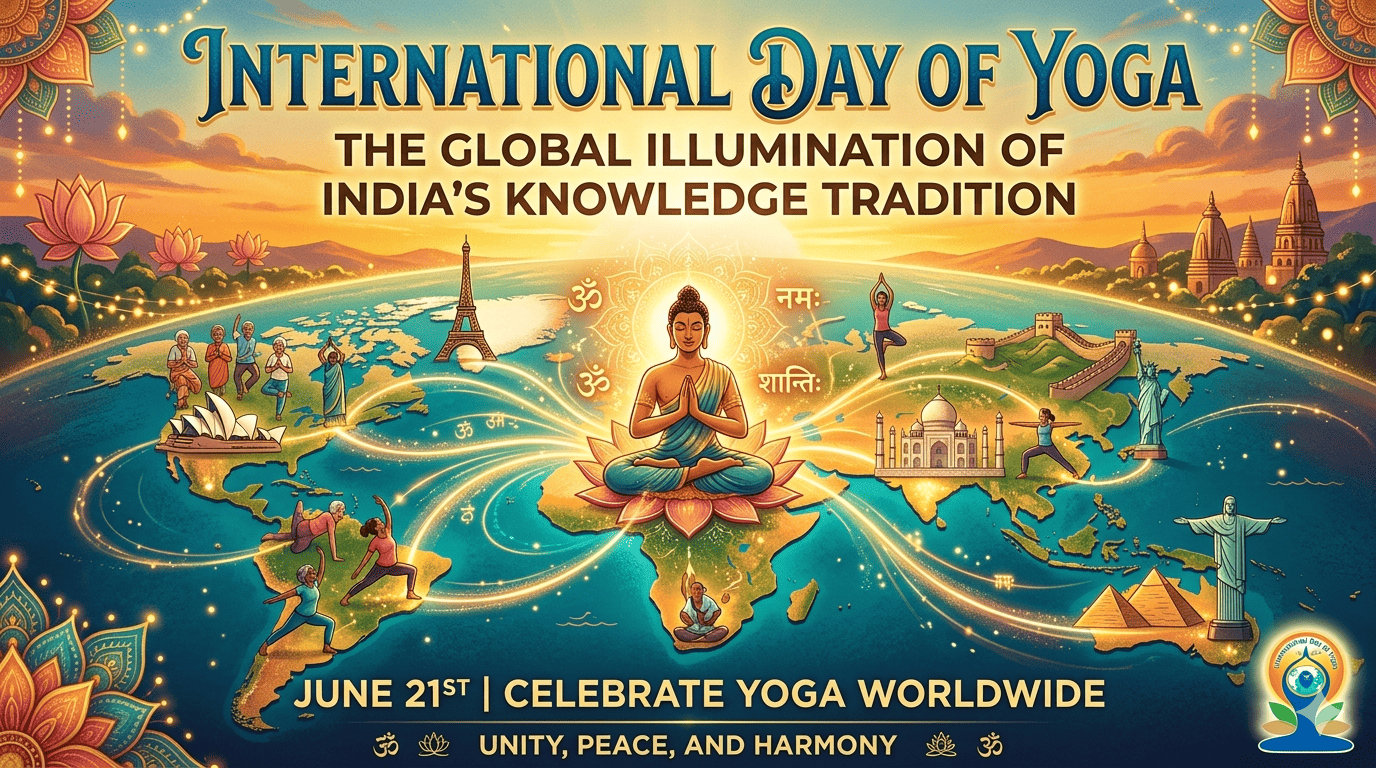
Every year on June 21, the International Day of Yoga is celebrated across the world. It is not merely a health campaign but a global celebration of India's ancient knowledge tradition, philosophy of life, and cultural consciousness. Yoga is deeply embedded in the soul of India. It represents a civilizational heritage that has taught humanity to view life in its entirety.
Thousands of years ago, Indian sages realized that human well-being is not determined solely by physical strength, but by mental peace, purity of thought, and spiritual balance. It was from this realization that Yoga emerged. The Vedas, Upanishads, Bhagavad Gita, and the Yoga Sutras of Maharishi Patanjali describe Yoga as the highest discipline of life.
India's Priceless Gift to the World
In 2014, India's Prime Minister, Narendra Modi, proposed the observance of an International Day of Yoga at the United Nations General Assembly. The proposal received unprecedented global support, and the United Nations declared June 21 as the International Day of Yoga. This marked a historic recognition of India's cultural diplomacy and its commitment to global well-being.
June 21 is the longest day of the year in the Northern Hemisphere and holds special significance in Indian tradition as a period of spiritual growth and heightened energy. Therefore, the selection of this date is also aligned with India's ancient wisdom traditions.
Yoga: A Philosophy of Indian Life
In India, Yoga is not merely a form of exercise; it is an art of living. The word "Yoga" means "union" or "connection"—the union of body with mind, mind with intellect, intellect with soul, and the individual with the Supreme Consciousness.
Practices such as Surya Namaskar, Pranayama, meditation, asanas, yama, niyama, dharana, and samadhi make Yoga a complete way of life. In Indian culture, the day traditionally begins with reverence for the Sun. Surya Namaskar is not only a physical exercise but also an expression of gratitude toward nature and the source of life-giving energy.
Why Yoga is Essential in the Modern Era
The present age is characterized by rapid technological advancement. While modern life has become more convenient, it has also led to increasing levels of stress, depression, insomnia, hypertension, diabetes, heart disease, and mental imbalance.
In the age of smartphones, computers, and artificial intelligence, physical activity has declined while mental pressure has increased. In such circumstances, Yoga emerges as an effective solution.
Yoga:
- Enhances physical health and flexibility.
- Reduces stress and anxiety.
- Improves concentration and memory.
- Strengthens the immune system.
- Promotes positivity and self-confidence.
- Encourages a balanced relationship with nature and society.
Yoga: A Confluence of Science and Spirituality
Yoga was once viewed primarily as a spiritual discipline. Today, however, numerous scientific studies have validated its health benefits. Modern medical science acknowledges that regular Yoga practice plays a significant role in stress management, respiratory health, cardiovascular wellness, and mental stability.
This is why Yoga has gained immense popularity in countries such as the United States, Russia, Japan, Australia, and across Europe. Millions of people around the world are embracing the Indian system of Yoga to lead healthier and more balanced lives.
The Younger Generation and Yoga
There is a growing need for the younger generation to embrace Yoga not merely as an annual observance but as a daily practice. Promoting awareness about Yoga in schools, colleges, and social institutions is the need of the hour.
Yoga is both a symbol of our cultural identity and a foundation for a healthier future. As the nation that gifted Yoga to the world, it is our responsibility to understand, preserve, practice, and pass on this invaluable heritage to future generations.
The International Day of Yoga is not merely an event; it is a celebration of India's eternal philosophy embodied in the prayer, "Sarve Bhavantu Sukhinah"—"May all beings be happy." Yoga offers us a healthy body, a peaceful mind, and a balanced life. At a time when the world is grappling with stress and imbalance, India's Yoga tradition has emerged as a beacon of hope for humanity.
Yoga is truly the soul of India, the essence of Indian civilization, and a pathway to global well-being. Therefore, making Yoga an integral part of our daily lives—not just a one-day observance—is the true significance of the International Day of Yoga.