

By Ranga Ranjan Das
Recently, we got the opportunity to interact with the members of the Deori community of Assam. They are intellectuals and respected persons of Deori society and the literary body as well. They are earnest about their culture and their heritage. Collective efforts have been made to explore the real ethno-history of Deori society and also to preserve the religious heritage of the society. The members of the society always takea close look at the facts and circumstances brought out by scholars and writers outside. They are one of the major plain tribes of Assam. Ethnically, they belong to the Indo-Mongoloid race and linguistically to the Tibeto-Burman family. They are a scheduled tribe (plains) population that constitutes 1.25 percent of the total scheduled tribe population of Assam (cited in Deori 2006: 53). Two words, Deuri or Deori, are used. In the words of Barua (1996: 162): “The Deoris constitute one of the scheduled tribes of Assam. Ethnically, they are affiliated with the great Indo-Mongoloid group, and they belong to the Tibeto-Burman linguistic family. The historians claimed them as one of the four divisions of Chutiyas who reigned over eastern Assam, prior to the advent of the Ahoms. These divisions are Hindu Chutiyas, Ahom Chutiyas, Borahis and Deoris. The Deoris were the priests of Chutiyas, though at present, each has acquired its own identity. There are four great territorial groups or khels among the Deoris, namely, Tengaponiya, Borgonya, Dibongiya and Patorgonya. The Deoris are riverine people and they sparsely inhabit the districts of Lakhimpur, Dibrugarh, Jorhat and Sonitpur of Assam.
In the present context, the Deoris are identified as one of the scheduled plain tribes of Assam. They are basically a riverine tribe, as seen in their present settlement areas. The identity as a Deuri came from Chutiyas. It is stated that the Deuris (Deoris) are one of the four divisions of the Chutiyas. The four divisions are Hindu Chutiya, Ahom Chutiya, Borahi and Deori (Deuri). The Deuris have been able to maintain their old traditions, religious beliefs and practices in spite of various socio-political changes over several decades or so (Bordoloi, Sharmah Thakur and Saikia 1987: 22).
History testifies to various facts and incidents associated with Deuri. It includes their role and position during the Chutiya and Ahom kingdoms as a priestly group, association with human sacrifice, conflict between the Ahom and Chutiya and movements towards Majuli.Deuri (2012:99) mentioned that “the Deuris are involved in the king priestly job (rajpurohit) with great honour at Sadiya during the reign of Nitipal, the last King of Chutiya Kingdom. As per legend, they also offered human sacrifice at the Tamreswari temple. The Deuris remained at Sadiya when the Ahoms overthrew the Nitipal, extending their empire to Sadiya. Prior to Ahom King Gourinath Singha, all the Ahom kings provided a high place to the Deuris in the kingdom for their priestly duties. Gourinath Singha banned human sacrifice. There is a legend that reveals that internal conflict started in the Ahom kingdom after Deuris banned the custom of human sacrifice. The position of Deuris was demoted in the Ahom kingdom, and there was also an invasion by the Burmese (Maan). For these reasons, the Deuris left Sadiya and settled in Majuli, erstwhile part of Sibsagar. From Majuli, they were spread out in the various places”. Deuri is involved in offering prayer in a debgreha (sacred place). The meaning of Deuri: de+gre+khya= debgreha. They like to introduce themselves as JimSaya. Jimsaya means: ji means water, ma means mosi (human), sa means sun, and ya means moon. They believe they are born out of the combination of moon, sun and water (ibid., p.99).
Scholars pointed out that the Deori originally resided on the river Dibong, Tengapani and Patarsal banks. These places are within the territorial jurisdiction of the Lohit district of Arunachal Pradesh. They are also settled in the Chapakhoa subdivision of the Dibrugarh district of Assam. During their abode, they had to face constant feuds with their neighbouring groups. Therefore, they had to move westward. As a result, they are distributed in the riverine areas of Lakhimpur, Dibrugarh, Sibsagar, Jorhat and Sonitpur districts of Assam (ibid Bordoloi, et.al, p 23). Apart from Assam, they are also distributed in the Lohit district with a population of 3608 (1944 males and 1664 females) according to the 1981 census. Linguistically, they do not differ from their counterparts residing in Assam. The Deuri residing in Arunachal Pradesh have two divisions (poja) and twelve exogamous clans (bojayo or jaku) (Singh, 1994: 229- 232). They have four main clans (faid). In the past, they mostly liked to reside on the banks of the river. It is revealed that the names of the four clans have a close nexus with the name of the river. They lived by the bank of the river Dibang, so there is a clan name known as Dibangya, by the river Tengapani, known as Tengapaniya, by the river Barnadi, known as Bargaya and by the river bank of Patorsal, known as Patorgaya. However, the Pator Gaya clan no longer exists in present times. Regarding the extinction of the Patar Gaya clan, Bhimkanta Barua and Lila Gogoi have their own observations. Bhimkanta Barua pointed out a legend and asserted that people belonging to Patorgaya were engaged in making human sacrifices to appease Tamreswari. Due to unavoidable circumstances, human sacrifice could not be executed on one occasion. Mother Tamreswari became very angry and caused blood vomiting in all people belonging to Patorgaya. All people died, and so there are no people of this clan. However, the existence of this clan member is not denied. According to Lila Gogoi, members of this clan are assimilated with the Tiwas tribes of Assam. According to another legend, while coming from Sadiya through the course of Brahmaputra, the boat carrying members of the Patorgaya clan is sink (ibid, 2012:99). Empirically in the contemporary context, it is found that the Dibangia section maintains the traditional language while the groups such as Borgonya and Tengapania have accepted Assamese language for communication (Bordoloi et.al 1987, p 24). Singh (1994: 232) states through the research of the Anthropological Survey of India: “The Deori are divided into a number of exogamous clans. The Deori are divided into a number of exogamous clans. Sundhariya, Patriya, Dupiya, Marangya, Chariya, Lagasuya, Chitigaya, Mehedaya, Kuliya, Airiya, Kumataya, Bihiya, Khutiya/Buruk, Machiya, Birromiya, Paporiya, Fagimegera, Senaboriya, Chakuchara, Ekacharul Busaru, Simocharu, Hizaru, Lopharu and Gucharu. The existence of two exogamous subdivisions in the Dibongya group has been reported.
They have their own language, but there are limited speakers. They have their own language, Deori, recognised by the government of Assam as of 28 January 2005. Linguistically, the language belongs to the Tibeto-Burman family. Deori Sahitya Sabha, referred to as Deori Literary body (Deori Susebba Sengchha), works for the development of the Deuri language and literature. It has been revealed that the number of speakers of the Deori language is decreasing day by day. The members of the Dibongiya clan still maintain the Deori language. Once, the members of Tengapania and Borgoya used the Deori language for communication, but they now accept the Assamese language for communication. They also face problems relating to their language. It is revealed that during 2005, while recognising the Deori language, the government asserted the implementation of the Deori language in the primary schools of Deori-dominated areas, which has not yet been done. It is also reported that 2006 interviews were conducted to appoint Deori language teachers in primary schools. The selected candidates were not appointed till 2012 (ibidp.100). Their economyis based on agriculture. However, they are facing different problems. They are living in riverine areas as well as in remote areas, which are mostly flood-affected during the summer season. Due to the perennial flood problems, they suffer a lot and are affected because they cannot raise mainly the Khariff crop, whose production is higher than the Rabi crop (Bharali and Borah 2001-2002: 26). However, a few of them serve in the government, and in semi-government and private organisations. Rice is their staple food. Rice beer (sujen) is part of socio-cultural life.
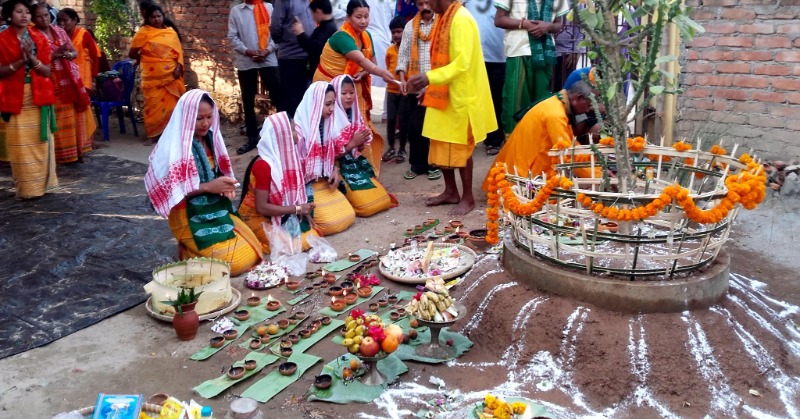
They possess a wonderful religious heritage. They are maintaining own religious beliefs and practices. They believe in the Kundi religion. The meaning of the Kundi religion is male-nature (purush prakriti). Different clans offer prayer under different names. Kundi mama is worshipped as Gira-Girasi (Bura-Buri) by Dibongiya, Pisa Dema (Boliya Baba) by Tengapaniya and Pisasi Dema (Tamreswari) by Borgoya. Kundi mama is regarded as the chief god. Apart from this, they worship various deities (sub-gods or goddesses), referred to as Midi. The sacred place of worship is known as a degor. Toconduct rituals according to their faith and beliefs, priests such as Bordeuri, Maju deuri, and Saru deuri are appointed. They are respected people and possess a high position in society. Generally, persons with high values and respect are appointed as priests. If it is proved that they are engaged in anti-social activities, they are terminated from their respective post (ibid. p.101).
The earlier study of the Anthropological Survey of India reveals that in a few villages, they observe their traditional tribal beliefs. The 1971 census records 99.47 per cent of the Deori as followers of Hinduism, 0.46 per cent as Christians and 0.07 per cent as Buddhists. 1961 census returns do not show any significant change. Their chief deity is Gira Girachi; Picha Dema and Pichachi and Demachi are the two other important deities. The offices of ritual experts like deuriand harali are hereditary and confined to a particular clan (cited in Singh 1994: 229- 232). In a traditional religious context, the role of a priest is important. However, in the changing context, members of the new generation do not show interest in accepting the role of priest. Religious activities need to be managed by two persons (ibid., 2012: 101).Regarding their religious beliefs and practices, Bordoloi, Sharmah Thakur and Saikia (1987: 30-31) note: “All the three sections of the Deoris are still maintaining their traditional beliefs and practices. However, the influence of Vaisnava Gosains is visible in the Deori villages, but the trend towards traditional beliefs is still prominent. The common place of worship among the Borgonya and Tengapania sections is known as a than (shrine), while the Dibangias call it midiku. All the sections worship Lord Shiva and Parvati as chief deities. The Dibangias call this supreme deity ‘Kundi Mama. ‘Kundi’ is identified as Lord Siva and ‘Mama’ as Parbati of the Hindu pantheon. Another name for this chief deity is Gira Girachi, Pisa Dema or Balia Baba, and Pisasi Dema or Kesaikhati. The son and daughter of Gira Girachi are two other important deities of the Deories. They also worship Gailurung Kundi as Ganesh and Kunwar Kundi as Kartick. The puja paraphernalia as include flowers, sacrificial dao, a piece of Chandan wood, copper, Argha, bell, trident, conch, brass basket, copper utensils, and canopy. The priestly functionaries include BorDeori or Baderi, Saru Deori or Saderi, Bor Bharali, Saru Bharali, Kelua, Bora, Barik and Randhani or Ladani. These office bearers are essential in all the than pujas and their offices are hereditary. Besides the major deities, the Deoris have a good number of household deities. They believe that if these deities are worshipped regularly, then peace and plenty will prevail upon the households. Sacrifices are offered to these deities. Some of the important household deities are Bakanmak, Miruchi, Kin, Dua Chitere, Bura Dangaria, Mora, Chakchik, Achira, Chanyan, Gharar Deo, Yan Terba, Jiomidi, Makchiba, etc. From the names of household deities like Bura Dangaria, Gharardeo, etc., the influence of non-Deori Hindus may be traced. Sacrifice of animals and fowls, pigeons form an important part of the Deori puja. The presence of Bor Deori or Ba Deri is essential in the pujas. Rice beer is not offered to the deities, but consumption of rice beer after the puja is not forbidden. Wednesday is the most auspicious day for worship, and pujas are performed either on Wednesday or on Sunday. Some of the Hindu rituals, like Durga puja, Saraswati puja, Janmastami, etc., have been incorporated recently into the religious structure of the Deoris. As worshippers of Shakti, the Deorias do not feel much difference when they worship Goddess Durga during the Durga Puja festival of the Hindus.
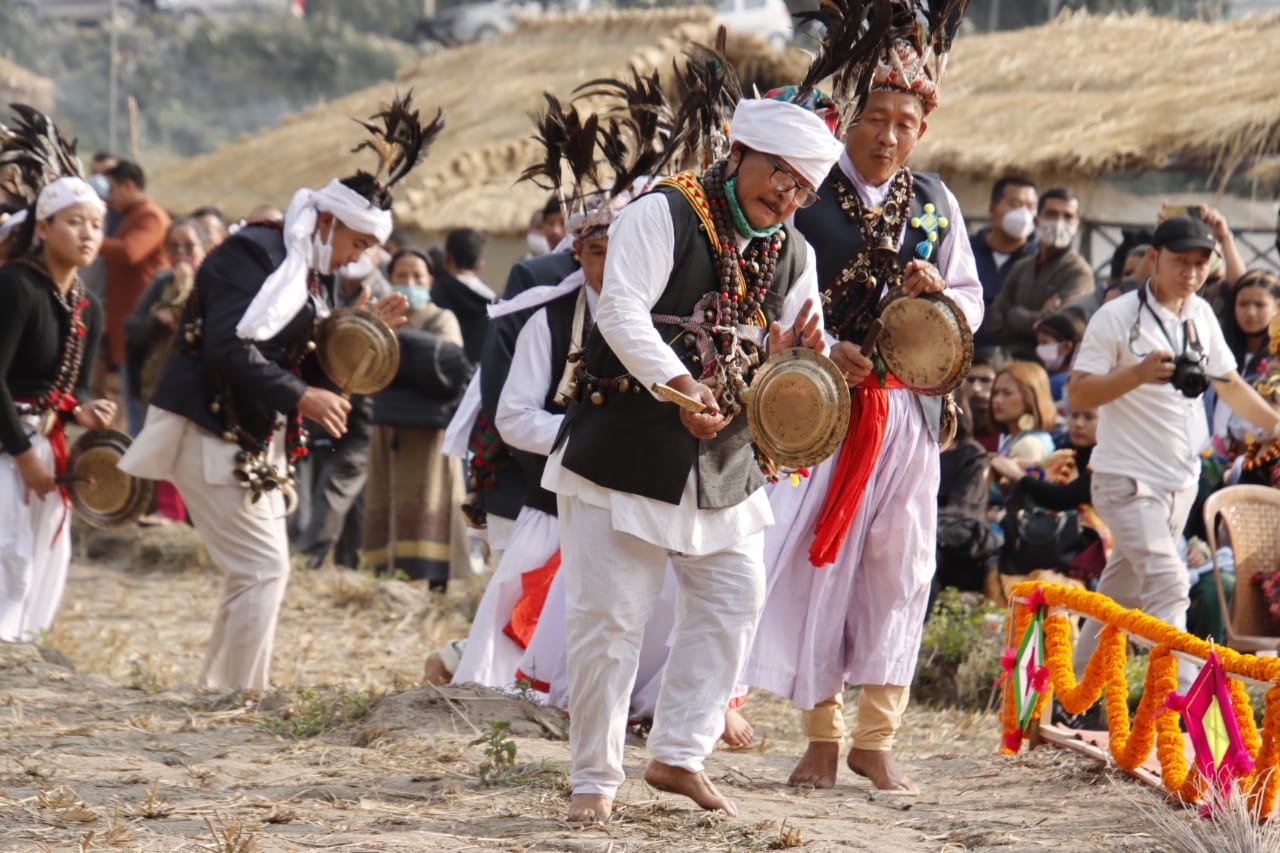
Among them, aspects of religion are well organised. It is reported that for the smooth functioning of their religious activities, every village has nine office bearers who have been assigned specific duties. Four office bearers are set in the hierarchical order, such as Bordeori or Baderi, Sarudeori or Saderi, Borbharali and Sarubharali. Generally, Bordeoris are selected from Bordeori clans like Sundariya, Machiatika, and Ikucharu. They are highly respectable person in the village. There are some qualities and duties associated with the post. Generally, a Bordeori should possess high moral values and be free from all sins. He looks after the rituals in the than (shrine). The Sarudeori assists the Bordeori. He is empowered to perform the duty of the Bordeori in his absence. The Bharali remains in charge of the puja paraphernalia. He collects dues and other essential articles from the villagers on ritual occasions. All the clans have equal status at least theoretically, but in practice, the Bordeori gets high status among the office bearers. The other office bearer is Deodhai, who plays a significant role in the religious life of the people. During dancing, he is believed to be possessed by their benign deity and also believed that he got the power to forecast the fortune of the villagers and about the natural calamities that may occur (ibid, 1987: 27-28). In spite of various problems, the Deori society is always in favour of peace and brotherhood among all the other neighbouring societies. Over prolonged contact with the Assamese caste population, some changes have been found in the societal contexts.
Bibliography
Deori, Basanta (2006) ‘Religious beliefs and practices of the Deoris’, Bulletin of the Assam Institute of Research for tribals and scheduled caste, Vol 16, Guwahati: Assam Institute of Research for tribals and scheduled castes, pp 53-54
Barua, I. (1996), ‘Child rearing Practices: A study among the Deoris’, FA Das and I. Barua edited Communities of North-East India, New Delhi: Mittal Publications, pp 161-170
Bordoloi, B.N., G.C. Sharmah Thakur and M.C. Saikia (1987), Tribes of Assam -Part 1, Guwahati: Tribal Research Institute, pp 22-35
Deuri, Saurav Kumar (2012), ‘Deuri Janagosthir Astityar Sankat and Sambhabana’, Asam Sahitya Sabha Patrika, 66th Year 4th issue (March, April, May), pp 99-102
Singh, K.S. edited (1994), ‘Deuri’, The Scheduled Tribes, Anthropological Survey of India and Oxford University Press, pp. 229- 232
Bharali, P.N. and AK Borah (2001-2002), ‘Educational problems among the Deoris- A plain scheduled tribe of Assam’, Bulletin of Assam Institute of Research for Tribals and Scheduled Castes, Vol 1, No XIV, 2001-2002, Department of Plain tribes and Backward classes, pp 24-27
Saikia, P.C. (1976), The Dibongiyas-Social and Religious Life of a Priestly Community, Delhi: B.R Publishing Corporation