

By Uddipta Talukdar
1.1 Brief Introduction to Hajo
Hajo is a term which came from Tibet-Burman language group. Dimasa-Kacharis use the word. 'Haju' to refer to the hills or hilly areas. Rabhas and Koches use the word 'Hassu' to refer to the same. The name itself suggests that it was earlier the place of tribals. It is considered as the city of five sacred places (Pancha Tirtha). Temple of Hayagriva Madhava is considered one of them. Hajo is also one of the center place famous for bell-metal works. Vaishnava Saint Madhava Deva stayed here in Ramdiya for few years before moving to CoochBehar in the last period of his life. Hajo is a place of unity and harmony. Puwa Macca, a sacred place for Muslims is also situated here. Impact of industrialization is clearly visible here. Most eminent personalities like second chief minister of Assam Sri. Bishnu Ram Medhi belongs to Hajo. It was also one of the center place of Buddhism which is also to be discussed below in short.
1.2 History of Hayagriva Madhava temple
Through the architecture and sculptures of the temple we can make sure that it was first constructed during the reign of Mleccha dynasty of Salasthambha (from the last part of 7th-10th century AD). During the reign of Dharmapala Kalika Purana was written where there is the mention of this temple in brief. Hence the temple is older than him. i.e. 12th century AD. According to Kalika Purana¹:
'Warnásháyáh dakshinasyáng Lohityo nám ságarah!
Manikutoh sthitah purbey Hayagribo Harirjatah (74)' (Kalika Purana, Chapter 78)
(To the west of river Warnasha there is an ocean called Lohitya. Manikut hill is located to the west of Lohitya where there is the idol of Hayagriva)
According to the slokas 75 and 76 of chapter 78 of Kalika Purana, lord Vishnu in the form of Hayagriva had defeated and killed two demons namely Jarasura and Hayagriva and stayed here in Manikut hill permanently for the welfare of the common people, gods and demons:
'Sa Hayagriba rupen Bishnurhatwá Jwarásuram! Nihatya sa Hayagribah krirháyoi jantrasa sthitah (75)'
'Hatwá Jwarang tathá Bishnustatra básamathakarot! Naradevásurádináng jathá bhawati boi hitam (76)'
There is a belief that Ourba Muni was a saint who had established the temple. He was the son of saint Bhrigu Muni. Shantanu Kaushik Baruah mentions about a myth that Madhu and Kaitav were two demons who had forcefully captured the four Vedas (Hindu religious text) from Lord Brahma and had hide them under water i.e. Ras?tala. Due to the request of Brahma Lord Vishnu in the form of Hayagriva had rescued all of them. Later he had also defeated and killed both of the demons².
There are certain architectures and sculptures that connect the temple with Buddhism. Buddhist people of Bhutan belief that here in Hajo, Buddha attained the ultimate state of liberation i.e. Parinirvana. In the east-south direction of Kedar temple there is a Sál tree (Shorea robusta) under the shade of which Buddha died. People of Tibet also says that SiddhaPadmanava, the founder of Lamaism, also died here. In his memory Bouddha stupa (Buddhist Shrine) was build. Upon which the idol of Buddha was installed. They therefore consider Hajo as their sacred place for worship. Devotees from Bhutan, Nepal, Tibet and China come here and says that their Mahamuni is in Hajo. They refer the statue of Hayagriva Madhava as Dorji Dolo, Shakya Thubá, Sensá Muni. Bhutanese Lamas call Hayagriva Madhava as Namoguru i.e Padma Sambhava. They call other deities as Ugáyan Guru, Douraj Dolá, Burha Madhava as 'Sáká Thubá' Sensá Muni³. Residualparts of Buddhist shrine (stupa) is found abandoned beneath the hill under a tree. According to Dr. Monoranjan Dutta it belongs to before 9th century.
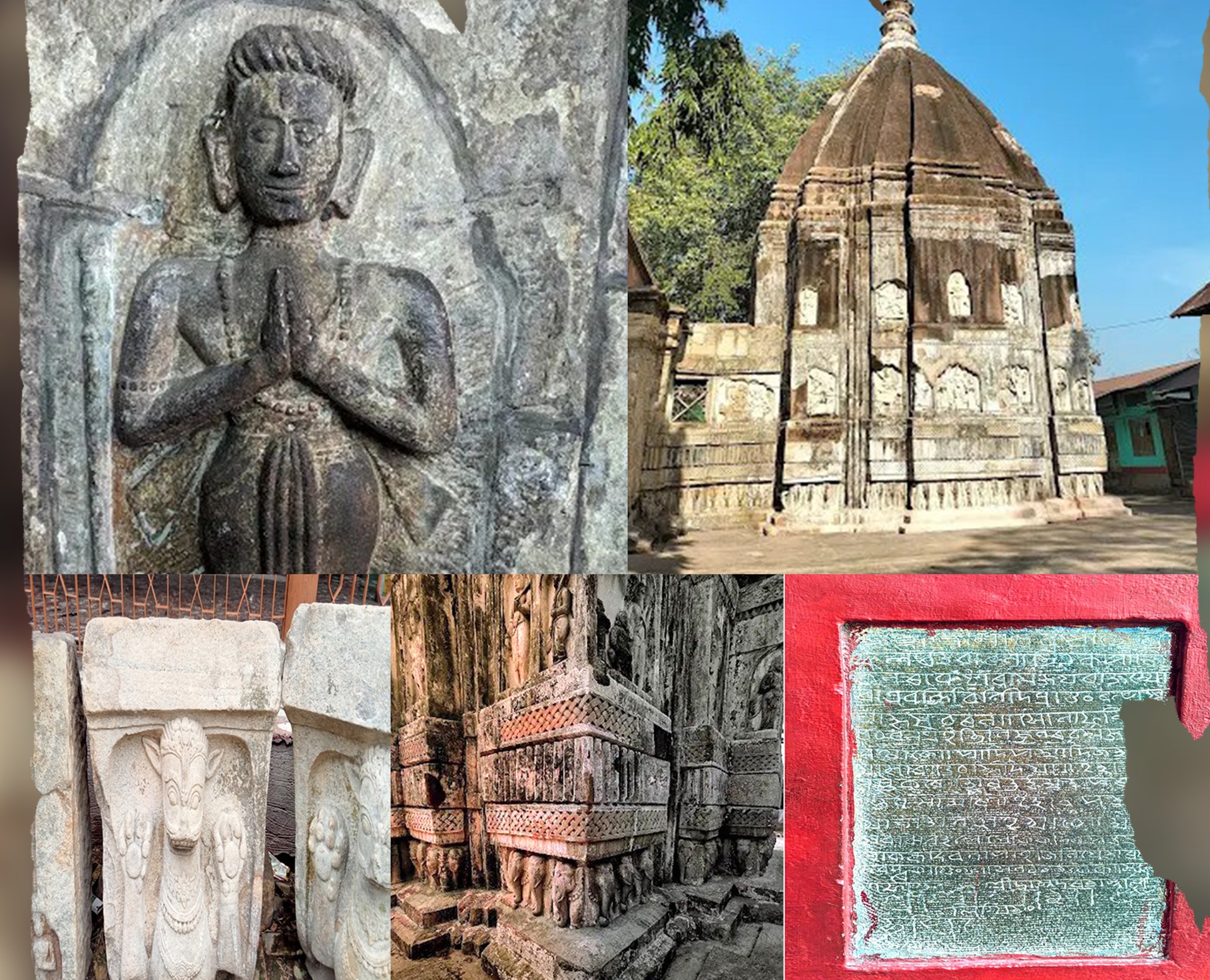
There is mention of this temple in Yogini Tantra also. Yogini Tantra has a mention of Koch king Biswa Singha as Binu Singha which signifies that during his reign the temple was not abandoned. The temple was again rediscovered and reconstructed by Koch king Naranarayan (1533-34 to 1587 AD). He had donated land 'Devottar' for the temple4 . The glimpse of art form of New-Vaisnavasect of Srimanta Sankara Deva in the sculptures proves the same asduring the reign of King Naranarayan the New Vaisnava movement was in it's peak. After the invasion of Kálápáhár in 1553 AD the temples of ancient Kamapura including the temple of Hayagriva Madhava were destroyed by the invaders. According to the rock inscription of Koch king Raghudeb Narayan (son of Koch chief Sukladhwaja the brother of king Naranarayan) had reconstructed the temple in 1505 Saka or 1583 AD. He mentioned himself as Bhupati (land lord) along with the names of Biswa Singha, Naranarayan and Sukladhwaj in the inscription5. He had employed Sridhar to construct the temple. The rock inscription engraved at the right side wall of the temple's southern entrance is of the time of Koch kings. By looking at the pattern of the letters Dr. Monoranjan Dutta suggests that it is of the time of King Raghudeb Narayan .
Ahom king Pramatta Singha had constructed the Nátghar (temple theatre) and Phalgutsava Doul or Temple (shrine where the idols of gods are installed during the celebration of Holi). Rock inscription of Phalgutsava Temple (Doul) of King Pramatta Singha of 1672 Saka or 1750 AD reinforces the validation of the same. There is a copper plate inscription of land grant towards akhanda pradipa (unbroken lamp) by Ahom king Gaurinath Singha in the year 1788 AD is also very significant. Copperplate inscription (1727 Saka or 1805 AD) of endowment of servitors to the temple made by Pratapavallabha, Barphukan's wife, under the reign of king Kamaleshwar Singha is also a significant part of the temple's history. Madhava or Mahamuni (according to Buddhist community) temple is a place where people of different religion, caste, language and community unite. Its role in Assam's history cannot be neglected.
1.3 Architecture of the temple
The architecture of the temple can be divided into three era:
1) Architecture and sculptures of Mleccha dynasty (before 9-10th century) as per theinformation given by Dr. Monoranjan Dutta.
2) Architecture during the reign of Koch kings (sculptures of incarnations of lord Vishnu reinforces it's validation)
3) Architecture of Ahom period
The top of the temple i.e. the Shikhara of the temple is of Rekha-Nágara style out of three types of Indian temple architecture. The lower exterior part of the temple has three layers of stone-cut thrones:
1) Gajásana or elephant throne (beneath Kush?sana)
2) Kushásana or throne of Halfa grass (beneath Padmásana)
3) Padmásana or lotus throne
These are considered as the glimpses of Buddhist architecture.
The elephants carved at the lowest level of the temple walls are 124 in number. The structure of continuous row of carved elephants is akin to the stone cut temple of Ellora. It is here necessary to mention that the effect of Hinduism in ancient Kamarupa was stimulated from the time of King Mahendra Varman of Varman dynasty during 5th century AD. During his time he had performed several sacrifices as being mentioned in Dubi copperplate inscription of Kumara Bhaskar Varman of 7th century AD. But gradually due to the influence of Buddhism (especially Tantric Buddhism) Vedic culture got somewhere lost. Evidently Adi Sankaracharya found it necessary to debate with Buddhist teacher Abhinava Gupta to re-establish Vedic culture in 9th century in Kamarupa6. Hence it can be stated that Hinduism got a new lease of life here in the 9th century. The residuals of the temple kept aligned in the field have holes in them which indicate that the time when the temple was constructed, use of traditional cement was not known. But in different parts of the body of the temple, presence of traditional cement (Korál) can be easily observed which informs us that it was being renovated several times by Ahom kings also. This residuals also reinforces the validation of attack of Kálápáhár. The sculptures of ten incarnations of Lord Vishnu including Matsya, Kurma, Barah, Nrisimha, Vaman, Parashuram, Rama, Krishna, Buddha, Kalki where Buddha is kept in ninth position above the sculpture of Vayu (the god of wind) riding a deer. Here Buddha is also considered as Vyasa by many people. There are sculptures of other mythological characters carved on the walls including Surya riding the bird Arun accompanied by two of his wife Chaya and Sandhya, a saint or Muni holding a garland, Darpa Muni (Proudy Saint) keeping his hand on his chest etc. A complete pot sculpture was kept at the campus in front of Nát Mandir. The pot is made completely of stone. Sculpture of Varun or rain god riding a crocodile (magar) is also very significant. The tradition of tiger hunt by the kings of Kamarupa is also being showed here in the form of sculpture. The king hunting a tiger by riding an elephant is carved at the temple wall at the top layer. Moreover the tradition of bringing a bunch of bananas as a offering to the temple is also demonstrated aesthetically with women wearing Chadar-mekhela and covering their head with veil. One woman carrying her child in her arms is the most beautiful demonstration of the traditional village life of that era in the ancient Kamarupa.
The Nrisimha carved on the temple wall is of North Indian style of temple architecture. But the one carved on the stone kept abandoned in front of the temple is the reflection of Vaisnava art form as the face of the said Nrisimha is similar to a horse akin to the Mask of Nrisimha used in the Satra tradion of Assam .
The main temple is divided into:
1) Garbha Griha or womb chamber inside which the idols were kept in the following order: Burha Madha 'Vishnu' in the centre, to his left Hayagriva or Dwitiya (second)Madhava (akin to Jagannath of Puri, Orissa), to his left Garuda. To the right of Burha Madhava there is Govinda Madhava or Salanta (movable) Madhava, to his rightVasudev. There is three unbroken lamp (akhanda pradip) in front of them. The base of the chamber is made of stone.
2) Jagmohan (to the west of Garvagriha): in this chamber at the centre there is an elevated platform rectangular in shape and made of stone called 'Bhutiyá Dhápo'. Upon which which Salanta Madhava or Govinda Madhava was installed temporarily during the performance of temple dance (Deva Dasi Nritya). Moreover upon it Bhutanese people light up the earthen lamps, incense sticks and keep their other offerings whenever they visit Hajo7. The pillars inside Jagmohan has patterns of lotus petals at their lower part. Walls of both the side of the chamber has patterns in the form of lotus. The whole chamber is made up of stone.
3) Nát Mandir or the temple theatre in the west of Jagmohan.
4) Bhoga Griha or chamber where divine grace or prasada for the deities are prepared is in the north of Jagmohan.
There is a myth regarding the western gate of the temple. There is belief that if we travel straight through the gate in the same direction we will reach Jagannath temple of Puri, Orissa. People believe that both Hayagriva Madhava and Jagannath are facing towards each other. At the north-west direction of the temple the Doul Griha or temple is located (of Ahom period).
At the east of the main temple there is a Lakshmi temple and Yajna mandir or temple. According to Muhin Deka, the tank beneath the hill Manikut is locally known as 'Madhav Pukhuri or Madhav Gokháir pukhuri' (tank of god Madhava) 'Vishnu Pushkar'. It is of 17 Bigha or 160.623 Acre.
1.4 Deva Dasi Dance associated with the temple
The Deva Dasis or temple dancers were selected from Nata-Kalita community or Gandharva-Kayasthas. They were divided into three broad categories:
a) Natis or dancers within the temple who used to perform for their pleasure of the deity.
b) Beshyâ or courtesans who were expert in dancing and singing of a secular kind and used to hold the ceremonial fans at both sides of the idols.
c) Ordinary dancers who used to perform in public places during marriages and other festivals for popular recreation.
The existence of a musical and dance tract known as Hájowaliyá Bájaná, and its use in the Deva Dasi dance performed in Hayagriva Madhava and Kedar temples in Hajo is noted by many authorities. There were also a dance norm (or gesture) called Kharmará or Khat that was used in Nati Nách or Deva Dasi dance of Hajo. The Deva Dasi dance of Hajo was originally prevalent in the Kedár or Kedáreshwarsiva temple. However, the Deva Dasis and the dance were transferred from here to the Hayagriva Madhava temple when soldiers of Mohammad-Bin-Bakhtiyar or Ikhtiyaruddin took shelter in the temple after they were defeated by Kámrupi soldiers in the 13th century AD. Atul Chandra Hazarika had wrote a poem 'Hajor Nati' in Assamese on them in Assamese magazine 'Abahon' in the year 18578. Dr. Paban Bordoloi quotes one the song sung by the dancers in the temple of Hayagriva Madhava in his book 'The Deva Dási Art Form of Assam' (English Translation), Pg. xi-xv, which is mentioned below:
'jayahe jaya jaya jaya ârati káshnâi murâri I
Hâi hâi câki- gachâ dhup bâti II
save gopi hâtâhâti I
We pay homage to you O' Krishna. O Murâri, all the Gopis are also singing of your virtues with sacred lamps sand incense-sticks in their hands. And the beauteous Râdhikâ is worshipping you with such devotion!
Gandharva Kayasthas or Nata-Kalita were the community associated with music and dance. Beside the dancers and singers the other members of this community were employed in different positions in the temples. The brother of Nati or female dancer was customarily employed as M?li or Gardener in the temple. Other relatives were employed as musicians in many of the temple. The various other duties of a Deva Dasi are keeping the interior of the temple clean, taking part in the ritual bathing of the idol, drawing water for rituals in the temple and holding the ceremonial fan beside the idol etc. Female dancers or Natis attached to a temple were not allowed to enter into matrimony while in service. They used to live with their parents and get married only after leaving service in the temple. Younger brother of such dancers also used to take part in dance performances organized in or around the temples. This tradition of temple dance is no more in practice in Hayagriva Madhava temple. It was existing till 19th century AD until the arrival of Britishers in Assam. But without it's mention the discussion will be incomplete.
1.5 Festivals and Ceremonies associated with the temple
According to Muhin Deka, public gathering is more during the month of Kati (November-December), Magh (January) and Bohag (April) as per the Assamese calendar. In the month of Kati offering garland of sacred Basil leaf is considered positive and it is believed that by doing that our every wishes gets full-filled and blessed us for our well-being. From the last day of Puh (December-January) i.e. Uttarayan or Makar-Sankranti the fair occurs for up to seven days in the month of Magh. On the very first day of Magh, fight of Bulbuli or Persian Nightingale bird is the main attraction for the tourists during Magha Bihu celebration. It was organized in January 2025 overcoming all the restrictions but due to the efforts of socialactivists and organizations dealing with nature and environment it is again banned to perform. People from Bhutan comes during the winter season to worship their deity Mahamuni. Holi is celebrated here in two types9:
a) Govinda Doul: it is celebrated for three days. It begins with Meshdáh or burning of temporary hut of straws (Bhelá Ghar). After that idol of Salanta Madhava is circumambulated around the Doul Mandir and installed upon it. This ceremony is similar to a marriage ceremony of Assamese society. Women perform community hymns akin to Assamese traditional marriage songs. For three days the idol is kept there and worshiped performing several rites and rituals. After three days the idol is taken for a tour of the town. That day people celebrate Holi by playing with colors. Kedár and Kámeshwar also comes from their respective temples and meets Madhava and sweets were offered to the three deities and are taken to Sátdalá field where they were traditionally welcomed and after certain rites and rituals they were taken back to their respective temples.
b) Raja Doul: it is considered as the second Holi of Hajo and being celebrated for five days on Shukla-Dwitiya tithi (according to Hindu calendar) next after Govinda Doul. It is believed that once a Queen was unable to enjoy Govinda Doul due to menstruation. And hence the king decided to re-celebrate for the queen. The king was assumed to be Ahom king Siva Singha or Rudra Singha or Pramatta Singha. Hence this Holi is termed as Raja Doul. The rite and rituals are similar to Govinda Doul. It is only being celebrated in Hajo.
Madanotsav: celebrated in the month of Sot (March) Krishna Trayodashitithi according to Hindu calendar. It is also known as Soitráli. Here also the three deities Madhava, Kedáreshwar and Kámeshwar is taken for a tour of the town and the new component in it is the mountain-shaped shrine decorated with light called 'Parvati' carried along in the front. The water gun 'Mot' specially prepared by the skin of newborn male goat is used to sprinkle water on the idols of the deities. 'Parvati' is made by the particularly selected people 'Khewáit'. Under 'Mot' colorful and fragrant water is poured. At the same time people perform community hymns playing several musical instruments and along with it they dance in joy. This way they reach the bank of the river Lokháitorá. At Sakiyághát the most attractive ritual of this celebration=n 'Dálá Khel' is held. It is a game played by two groups in river water. It can be termed as water fight or 'PániJuj'. New Vaishnava movement is consider one of the cause for Madanotsav getting gradually extinct.
Manikut Festival (Utsav): On the first day of Magh it is celebrated with the cooperation of All Assam Students Union (AASU) where priests of Puwa Mecca i.e. Khadim and the priest of Hayagriva Madhava temple i.e. Doloi also participate. A rally from PuwaMecca to Hayagriva Madhava temple is taken out showcasing cultures and traditions of different tribes and communities of Assam and Northeast India. The main motif of its celebration is to strengthen the unity in diversity of Assam irrespective of religion, caste, language, tribe or community etc. It was first organized by the above mentioned studentpolitical organization in the year 1993. (People of Hajo have a great emotion with the said temples and all this festivals andceremonies. Their sentiments regarding the Nightingale fight can be felt during the conversations with them during the field survey).
1.6 Role of the local people towards the maintenance of the temple
In all the temples, three positions or professions known as Bráhmana or Seváti, Nata/Nati or dancer and Málákár or garland-maker were created to perform various functions. Among the Málákárs themselves, there used to be gardeners of different grades like
1) Máli
2) áthpariyá
3) Bharáli,
4) and ordinary Páik
Members of Nata-Kalita or Gandharva Kayasthas were employed in different duties in the temples. As mentioned above that the younger brother of DevaDasis were employed as Máli specially in Dubi Pariharehswar temple10. At present century also Málákárs of Hajo are involved in the temple duties. The members to be elected for the temple maintenance committee who looks after the interior works of the temple including the priest should be from the Doloi Samáj (society of the people of upper class), engaged in the maintenance ofthe temple. The other people including Málákárs are involved in various exterior works in the temple. In fact, Muslims are also involved in the temple maintenance committee and have the right to vote during the election of the members. The most respected person of this committee is the Doloi. The people 'Hát Khowá' are employed for the hospitality of the visitors from Bhutan¹¹.
1.7 Conclusion
The temple is one of the main centers of tourist attraction. The preservation of the temple architecture and monuments will enrich the tourism of that particular area. The local people living nearby are engaged in different occupations depending on the temple, like selling sacred Basil garlands, flowers for the devotees to offer to the deities, hotels and restaurants nearby, to facilitate the devotees with meal and pure drinking water. People involved in cleaning of the campus of the temple, folk artists like Muhin Deka performing folksongs 'Kamrupi Lokagit' at the entrance to the temple etc are living their life through the temple and support from the visitors. Hence the committee and government of Assam should give more focus for the smooth temple visit of the tourists. There is lack of clean and hygienic washroom for the pilgrims at the temple campus. The Doul Mandir and the entrance gates and other architectures and monuments are painted which led to the destruction of originality and beauty. They should be preserved and protected in their original form to reinforce the history behind the temple. The shelters for the devotees are to be constructed. The tank beneath the hill 'Madhava Pukhuri' or 'Vishnu Pushkar' is famous for unique species of turtles which are in danger for the carelessness of the visitors The local people staying nearby the temple are to be aware more about the temple's history to be a good respondents for the researchers. It will encourage visitors more to make an approach to know the past and present of the temple. A museum to preserve and showcase the copperplate inscriptions, ancient items and utensils reflecting the temple's past etc. is needed for the future generations. Many sculptures found damaged were repaired using cement. A broken head of a human figure made of stone is kept in open at the left of the southern entrance near Shiva Linga. A thin layer of cement and Sindur (vermilion or sacred red power) upon it makes it unable to recognize it. Through the structure of the head and earrings it might be an idol of Bhutanese or Tibetan Buddhist saint. In short the temple is one of the significant pillars of our Assam's history.
Bibliography:
1) N. Bhattacharya, Debendra (ed.). 2008, Kalika Purana, Pg. 1038
2) Kausik Baruah, Shantanu. 2020, Asama Kirtichihna, Pg. 166-167
3) Kalita, Samin. 2007, Hajo AnchalarItihash, Pg. 13-14
4) Amanatullah, Khan Chowdhuri, 1936, A History Of Cooch Behar (In Bengali) Pg. 125
5) Neog, Dr. Maheshwar (ed.). 2008, Prachya-Sasanavali, Pg. 3-4
6) L. Barua, K. 2020, Early History Of Kamarupa, Pg. 151
7) Kalita, Samin. 2007, Hajo AnchalarItihash, Pg. 16
8) Bordoloi, Dr. Paban. 2010, The DevaDasi Art Form Of Assam, Pg. 118-119
9) Goswami, Dr. Prafulladatta. 1975, Bahag Bihur Barebaraniya Chabi, Pg. 108-110
10) Bordoloi, Dr. Paban. 2010, The DevaDasi Art Form Of Assam, Pg. 1-4
11) Kalita, Samin. 2007, Hajo Anchalar Itihash, Pg. 14
List of Respondents :
1) Dr. Monoranjan Dutta, Retired IAS Officer, Address: Borbari, Guwahati
2) Mr. Muhin Deka, Folk Artist, Address: Ramdiya, Hajo
3) Mr. Bhavesh Nath Sharma, Priest, Joined the temple in 2002, Address: Pandu, Guwahati
4) Mr. Dinesh Sharma, Priest, Address: Baihata Charia