

By Dr. Indrani Medhi & Dr. Gargi Dutta Paul
Introduction
The preservation of cultural assets and passing the same to the generation next not only implies holding the past but also holding and securing it to the future. India is a home to the second largest Indigenous population in the world and with every year of urban development the indigenous population are left behind in the growth spectrum.[1] Tiwa Community is one of the many indigenous community of Assam.[2] The Jon Beel Mela is an occasion where the community showcase their culture and heritage to the outside word with pride. The word Mela is a Sanskrit word meaning a gathering or meet or a fair. India being a land of cultural and geographical diversities where different fairs and festivals form an intrinsic fabric of society and continuation of heritage. There are numerous festivals held in all corners of India like the Tarnetar Mela, The Pushkar Mela, the Kumbh Mela, the Hornbill festival to name a few. Jon Beel Mela is one such festival where the age old barter system comes alive.
Methodology
This work is an empirical study backed by secondary sources and personal observation. The data was collected from the participants and the visitors of the Jon Beel Mela held in 19th January to 21st January 2023 through interview method by the investigator.
History of the Tiwa Community
The Tiwas are one of the schedule plain tribes of Assam. The Lalungs prefer to call themselves as Tiwa. According to the Lalung language Ti means water and Wa means superior.[3] The Tiwas and the Dimasa Kacharis have close resemblance. Both the Tiwas and the Kacharis worship Lord Siva as their supreme God. The Tiwas also belong to the great Bodo race in which tribes like the Bodo Kacharies, Chutia, Rabha, Dimasa, Mech, Garo etc are included. Endle in his Ethnography on the Kacharis has claimed the Tiwas of Assam within the fold of the great Bodo race. So far as their migration from the hills to the plains are concerned there is no clear cut date about their migration, yet it can be assumed they migrated to the plains of Assam sometime in the middle of the 17th century CE. In 1658 Promoto Rai rebelled against his grandfather Jasa Manta Rai, Raja of Jayantia and called the tributary chief of Gobha to help him. The latter refused and Promoto Rai thereupon destroyed four of his villages. He appealed for help to the Kacharis who were preparing to come to his assistance when the local Ahom officials intervened and said that as the Ahoms was the supreme power and it was they whose protection should be sought. The Gobha chief accordingly went with seven hundred men to Jayadhavaj Singha and begged for help. Orders were issued to the Barphukan to establish him in Khagarijan corresponding more or less to modern Nagoan and this was done accordingly. Gobha has been mentioned in the Buranjis as an important market town. After the establishment of the Gobha Raja at Khargarijan several princely states came up. They were Morigoan, Neli, Silsang, Bangaldhara and Sahari. The Tiwa kings had several royal officers and their surnames are associated with royal assignment of various grades and ranks. Their descent is also traced after their professional divisions of labour in the royal management of their princedom. These officers are Patri, Bardoloi, Dekadoloi, Khatonio, Doloi, Tamuli, Doloi, Deuri etc.[4] Moreover, a principality known as Dimoria also finds mention in the contemporary records till the end of the 15 th century CE. This was perhaps the oldest stronghold of the Tiwas. But the principality could not grow as it was surrounded by other powerful communities like the Ahoms, Koch, Dimasa, and Jaintia.[5] However according to Hamilton the chief of Dimorua was probably a Garo and the principality was of considerable importance.[6] Moreover the early Ahom Buranji also did not mention the Tiwa (Lalung) separately because of their possible inclusion within the Dimasa community. The Tiwas mostly speak Assamese language. Tiwa language is spoken in the foothills and in the interior villages. So far as the physical features are concerned the Tiwas are medium statured, strong built and generally fair complexioned people which are the characteristic features of the Mongoloids. They have flat nose, straight hair, wide faces with scanty facial hair.
Objective of the Study
The paper is undertaken to study the genesis of the Jon Beel Mela. It also aims explore the traditional batter System and its role in bringing a cultural harmony and brotherhood amongst the different communities scattered in the hills and plains of North East India. Keeping in view the significance of the Jon Beel Mela as a platform to showcase the rich cultural heritage of the Tiwa people of Assam, this paper makes an attempt to ascertain the adequacy of the present legal framework at the national as well as at the international level for its protection which carries with it a legacy from the 15th century onwards.
Genesis of the Jon Beel Mela
The fair originated way back in the 15 th century, although fixed date of the event is yet to be known. There are many stories and narratives regarding the origin of the Jon Beel Mela. The history of this Mela is deep-rooted in the folk history referring to common origin of the chiefs or rulers of the hills and plain communities. According legend current among the Tiwa tribesmen of Morigoan and Kamrup states that there were four brothers from a place called Thinmowphlong located in Assam – Meghalaya border moved down from hills and established four separate kingdoms in Assam plains and Meghalaya. The eldest among them established their kingdom on Dimoria presently in the Kamrup district in the plains. The second eldest one founded the Gobha kingdom in the eastern boundary. The third one at Khoiram and the fourth one established the Milim chiefdom. The people claim that the last two lie in the Khasi hills of Meghalaya[7]. Initiated under the patronage of the Ahom and Gobha king purely under political and economic ground, it was originally known as Haat (mart) where transactions were done mainly through barter system between the hills and the plains while according to others, the Jon Beel Mela originated from the coronation ceremony of Langbar the king of Gobha at Phuluguri one week after the Magh Bihu festival in Assam. During the time of king Jon Sin the venue was shifted to the present location from where the name Jon Sing the Beel and the Mela got its name. While according to others the Jon Beel Mela was started by Rudra Singha. The purpose of these traditional fair was not barter alone. Most of them had political objective –to get tribal chiefs together so that they can abreast of socio political development. While the leaders deliberated politics and matters of state while others exchanged news, information and plain gossip. Epigraphic as well as literary sources reveal since the inception of the Ahom rule in the 13th century the Ahoms were engaged in internal as well as external trade. Domestic trade was based on barter and use of currency was limited. Economy was largely pastoral and self-sufficient. The Mughal chronicler who accompanied Mir Jumla in his expedition to Assam describes “it was not the practice of Assam to buy any articles of food in the market and all inhabitants store in their houses one year supply of food of all kinds and were under no necessity to buy or sell eatables”. The Buranjis further corroborates that the Ahom kings set up local markets and haats in various places to promote internal trade as well as keep peace among the various tribes. Mention can be made of Pratap Sinhga who set up two markets in Dopdar and Borhat to encourage an exchange of goods with the Nagas while Siva Singha established a market at Marangi to keep amicable relation with the Kacharis. It was with this aim in view that Rudra Singha established the Jon Beel Mela. Though diverse opinion exits regarding the origin of the Mela but a conclusion can be drawn for the different literatures that its origin can be traced back to the medieval period.
Jon Beel Mela in the Present Era
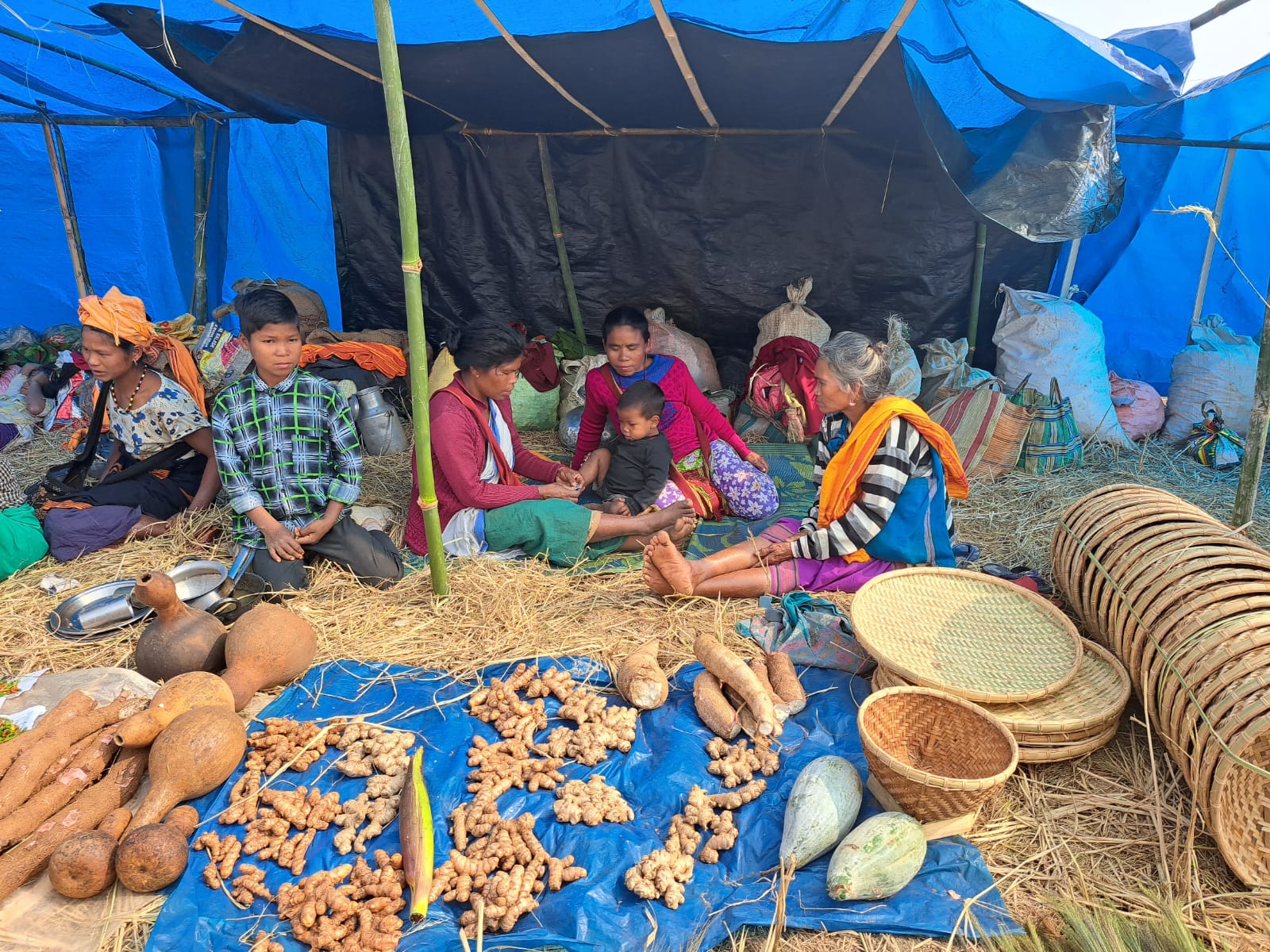
Jon Beel Mela is celebrated on the first weekend of Magh Bihu (Mid January). The historic Dayang Belguri at Jon Beel located just 5 km away from Jagiroad is the place where the fair takes place. Jon and Beel are Assamese terms for the moon and wetland and it is called so because a large natural water body shaped like the crescent moon. It covers an area of more than 5 acres of land which is managed by committee members near the Jon Beel Lake. Though the Tiwas are explicitly associated with fair but the participation of other tribes was also observed by the investigator. Invitation to the neighbouring regions are sent in a traditional way by sending Tamul and Paan (Betel nuts and leafs) to every village especially the borders area of Assam. A day before the fair the Gobha king offer prayer to their ancestral God Fa Mahadeva in the Dewsal temple. The event starts with fire worship where the local pay homage to the God of fire and then the community fishing takes place in the wetland. The Jon Beel Mela is organized under the auspicious of Gobha Tiwa Deo Raja Jonbeel Samiti and at the direction of Gobha-Tiwa Deo Raja Rajdarbar. On the first day of the Mela people from the Hill areas often designated as Mama Mami by the plain Tiwas come down with a variety of goods and starts settling in the temporary bamboo huts with reed and straw in the Mela ground. The visitors to the Mela and the participating tribes exchange commodities. A few days prior to the fair the different tribes such as the Jayantias, Tiwa, Khasi and Karbi descend down the hills with local products. The journey is not easy as the visitors have to carry all their essentials and supplies they intend to sell and barter at the venue. On the first day of the Mela people in the plain embrace and accommodate them and make arrangement for them to settle down. The King of Gobha also come and visits the Mela and have a ritualistic place at this Mela. The king is devoid of any administrative and political relevance and the presence is symbolic and is socially recognized.
The second day is the most significant day as the most awaited barter exchange takes place. Herbs, spices, fruits, ginger, artifacts and basic articles of necessity brought by the people of the hills exchange with the local folk of the plain. They include pithas or pancakes, dried fish, medicinal herbs, vegetables, spices, fruits etc. The things that the hill people procure are used to celebrate their feasts up in the hills. The bartering takes place early in the morning. By noon the visitors flock to the makeshift markets of household goods. With the setting of the sun the festival takes the form of Mela in common parlance where the traditional character of the Mela undergoes a change. Exquisite traditional dance and music are also performed by various tribes apart from cock fight. On the third day the Raj Durbar is held where the Gobha Raja presides and courtiers and other representatives of the administration also participate. Formal meetings are held where various issues are discussed.
Legal Framework for Protection of the Cultural Legacy of the Indigenous Population
The right to cultural heritage of the Tiwa people which is showcased to their generation next as well as to the world through Jon Beel Mela can withstand the erosion if supported by strong legal framework of protections both at the international and the national level.
International Law on the Protection of the Cultural Rights of the Indigenous People.
The Indigenous people continue to face challenges in preservation of their cultural identity and their cultural rights are constantly threatened.[8] Protection have been framed under various international instruments for the preservation of the cultural heritage of the Indigenous population of the world.[9]
The United Nations Declaration on the Rights of Indigenous People, 2006 which is a comprehensive instrument dealing with the rights of Indigenous people states that the indigenous people have a right not to be subjected to the destruction of their culture. The declaration further prohibits the nation states to do any act that deprives the indigenous people of their cultural identity.[10] The declaration recognizes the right of the indigenous people to protect and revitalize their cultural tradition and customs[11]. The declaration provides the indigenous people the right to transmit to their future generation their traditions and a duty is cast upon the nation state to take effective measures to protect this right of the indigenous people.[12] The declaration ensures that this cultural heritage is passed to the generation below through the system of Education.[13] The declaration was adopted by the United Nations General Assembly with 144 countries[14] including India voting in its favour, thereby creating an moral obligation on Government of India to Protect the rights of the Indigenous population[15]. Therefore the Jon Beel Mela being the cultural heritage of the Tiwa Community the Government is under the moral obligation of the international law to ensure adequate protection for the preservation of the Mela and include in the syllabus of the educational system to create an Pan India awareness of it.
Legal Framework at the National Level
The Constitution of India protects the cultural heritage of the indigenous people and the Tiwa community can thereby maintain their culture and its related avenues.[16] As the constitution guarantees the protection of the cultural heritage of the indigenous population of India, the Tiwa population can continue with the Jon Beel mela without any obstruction. The Constitution recognizes ‘custom or usage having in the territory of India the force of law’ as part of the term ‘law’.[17] Some basic conditions for their recognition as customary law includes whether it finds its source in antiquity; is reasonable; is in conformity with statutory law. Therefore, the customary system of Tiwa people is recognized in the legal system of India from which the Jon Beel Mela draws its legal validity.
Contribution of the Judiciary in the Protection of the Cultural Heritage of the Indigenous People
.In Orissa Mining Corporation Ltd. v. Ministry of Environment and Forest (Writ Petition (C) No.180/2011) decided on 18.4.2013, this Court recognized the customary and cultural rights of indigenous people living in Kalahandi and Rayagada Districts of Orissa. While considering challenge to order dated 24.8.2010 passed by the Ministry of Environment and Forests whereby the application made by the petitioner for grant of permission for diversion of 660.749 hectares of forest land for mining of bauxite ore in Lanjigarh Bauxite Mines in two Districts of the State was rejected, the three Judge Bench extensively referred to Saxena Committee report, which covered several issues including violation of the rights of tribal groups including primitive tribal groups and the dalit population and proceeded to observe:
The Court held that the customary and cultural rights of indigenous people have been the subject matter of various international conventions. International Labour Organization (ILO) Convention on Indigenous and Tribal Populations Convention, 1957 (No.107) was the first comprehensive international instrument setting forth the rights of indigenous and tribal populations which emphasized the necessity for the protection of social, political and cultural rights of indigenous people. Following that there were two other conventions ILO Convention (No.169) and Indigenous and Tribal Peoples Convention, 1989 and United Nations Declaration on the rights of Indigenous Peoples (UNDRIP), 2007 and therefore Court recognised the legitimacy of the cultural rights of the Indigenous people.
Conclusion
Though community centric the Jon Beel Mela enables the strengthening of the community bonds The Gobha king still commands respect and honour from the subjects. Attempt to manage the Jon Beel Mela can result in the transformation of this community event into a major festival of tourist attraction. The festival has also kept the relevance of the tribal king alive. It witnesses the Gobha Raja visiting the Mela on the final day and holding a darbar and listen to people woos and complains Fast forward to the contemporary times the age old barter system is still in use perhaps the only fair in India, where the barter system is still alive and that is why makes it unique. The international Law clearly cast an MORAL obligation on the Government to protect the tribal cultural heritage of Tiwa which is showcased to world through the Jon Beel Mela and also take affirmative step for ensuring that the tiwa community can continue this practice with the support of the government. The international law also requires that the mela be incorporated in the syllabus of the education system so that the traditional practice and knowledge of the people of the community get the pan India attention. The constitution recognizes the cultural rights of the people as the fundamental right. However fundamental right being a negative right it falls short to attract the requirement for affirmative action from the state thereby creating a disadvantage to the indigenous people. Moreoner the dissimilation of information through text books for the pan India reach is not reflected in the legal framework of the country and as a result of which the mela remains within the attention of a limited people of the region and that too due to the efforts of the people of the community alone.
Suggestion
1. The protection under legal framework in India should be enlarge to ensure it complies with the provision of the United Nations Declaration on the Rights of Indigenous People, 2006.
2. The information on the Jon Beel Mela should be incorporated in the syllabus pan India and also should be given wide coverage in the media to attract tourist national and international.
Endnotes
[1] https://www.rgaa.co.in/indigenous-people-of-india-a-cornerstone-of-the-indian-cultural-heritage (accessed on 21/2/2023).
[2] Article 366 (25) of the Constitution of India.
[3] G.C.Sharma Thakur, The Lalungs (Tiwa), Tribal Research Institute, Guwahati. 1985 p 10
[4] 73 Ibid p 7
[5] Shyam Chaudhuri and M.N.Das, The Lalung Society, cited in Shailendra Kumar Agnihotri The Lalung, S. Kumar And Associates, Lucknow. 1996 p 8
[6] Francis Hamilton, An Account Of Assam, cited in Shailendra Kumar Agnihotri op.cit., p 8
[7] http://dlkkhsou.inflibnet.ac.in:8080/jspui/bitstream/123456789/24/1/wp2.pdf
[8] www.http//ohchr.org/sites accessed on 24/2/2023.
[9] IlO Convention concerning Indigenous and Tribal People in Independent Countries,1989.(169),
[10] The United Nations Declaration on the Rights of Indigenous People 2006, Article 7.
[11] Article 8 Ibid.
[12] Article 11Ibid
[13] Article 15 Ibid.
[14] Supra1.
[15] https://www.un.org/development/desa/indigenouspeoples/declaration-on-the-rights-of-indigenous (accessed on 21/2/2023).
[16] Article 29 and 30 of the Constitution of India.
[17] Article 13 of the Constitution of India.
(Dr. Indrani Medhi, Assistant Professor Dispur Law College,
Dr. Gargi Dutta Paul, Principal Dispur Law College)