

By - GAUTAM SARMAH
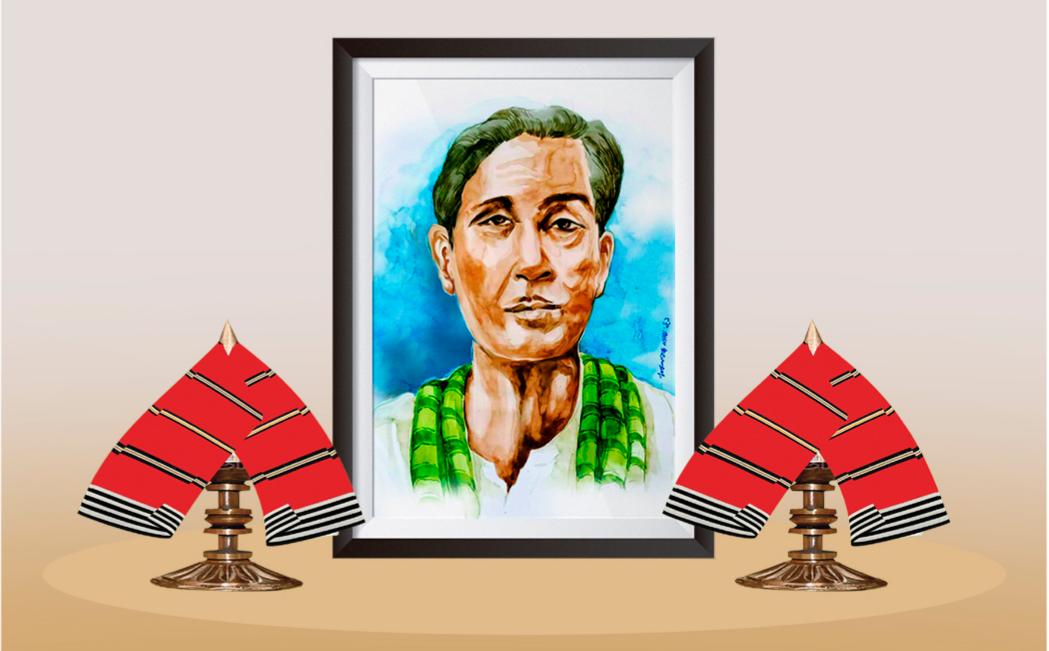
History remembers some leaders because they held important offices, won great political battles, or received national honours. Yet only a few leave such a lasting impact that the future of an entire region becomes closely linked with their vision and leadership. Lokapriya Gopinath Bordoloi was one such leader. More than seven decades after his death, his influence can still be seen in Assam's political structure, constitutional safeguards, educational institutions, and democratic traditions. For this reason, he is rightly regarded as the Architect of Modern Assam. Born on 6 June 1890 at Raha in present-day Nagaon district of Assam, Gopinath Bordoloi belonged to a generation that witnessed the rise of Indian nationalism and the struggle against British rule. After studying at Cotton College and Calcutta University, he began his career as a lawyer. However, inspired by Mahatma Gandhi and the national movement, he left professional life and dedicated himself to public service and the cause of India's freedom.
Like many freedom fighters of his time, Bordoloi was imprisoned for his participation in the independence movement. Yet his importance in history extends far beyond his role in the freedom struggle. His greatest contribution was his ability to protect Assam's interests while actively participating in the larger project of nation-building. Any assessment of Bordoloi's legacy must begin with the political crisis of the 1940s. The Cabinet Mission Plan of 1946 proposed a grouping system under which Assam would be placed in a section dominated by Bengal. This created deep concern among many Assamese leaders, who feared that Assam's political voice and distinct identity would be overshadowed by the much larger province of Bengal. At that critical moment, Bordoloi emerged as the strongest defender of Assam's interests. Through political negotiations, persuasion, and determined leadership, he opposed arrangements that threatened Assam's autonomy. His efforts played a crucial role in ensuring that Assam entered independent India as a distinct political entity. Many historians believe that without his leadership, Assam's political future might have been very different.
This achievement alone would have secured his place in history. However, Bordoloi's contribution was far greater. As Assam's first Chief Minister after independence, he faced enormous challenges. The state had to deal with the consequences of Partition, administrative reorganization, economic difficulties, and the urgent need for development. At a time when resources were limited and expectations were high, he provided stable and responsible leadership. Bordoloi understood that political freedom alone could not guarantee progress. He believed that strong institutions were essential for building a modern society. Consequently, his government gave importance to education, administration, public welfare, and infrastructure.
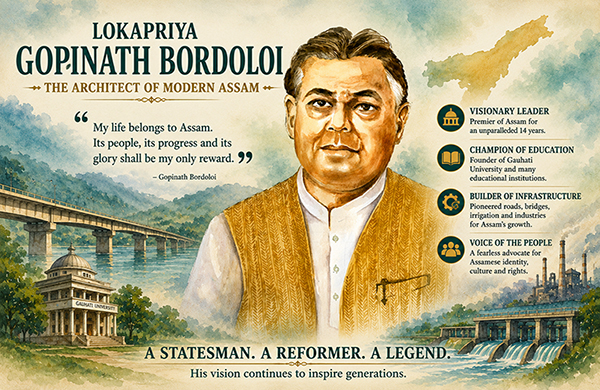
One of the most significant development during his tenure was the establishment of Gauhati University in 1948, the first university in Assam. The university played a major role in expanding higher education and intellectual life in the region. Bordoloi also supported the strengthening of educational institutions and encouraged initiatives that would contribute to the long-term development of the state. His vision was not limited to education alone. He recognized the importance of effective governance and worked to build administrative institutions capable of meeting the needs of a newly independent society. Many of the foundations of modern governance in Assam were laid during his leadership.
Perhaps Bordoloi's most remarkable contribution was his role in protecting the rights and identities of the tribal communities of Northeast India. The region is home to diverse ethnic groups, languages, and cultures. Bordoloi understood that this diversity should be respected rather than ignored. As Chairman of the North-East Frontier (Assam) Tribal and Excluded Areas Committee, he played a leading role in developing recommendations that later influenced the Sixth Schedule of the Indian Constitution. The Sixth Schedule created Autonomous District Councils and provided special safeguards for tribal communities. It protected traditional institutions, customary laws, land rights, and local self-governance.
Even today, these constitutional safeguards remain central to the political and cultural life of many tribal communities in Northeast India. The Sixth Schedule stands as one of the most innovative features of the Indian Constitution, and Bordoloi's contribution to its development remains one of his greatest achievement. Another important aspect of Bordoloi's leadership was his ability to balance regional interests with national responsibility. He loved Assam deeply and worked tirelessly for its welfare. At the same time, he believed that Assam's progress was linked to India's progress. He never viewed regional identity and national identity as opposing forces. Instead, he demonstrated that one could be both a proud Assamese and a committed Indian. This balanced approach remains highly relevant today. In an age when public debates often become polarized, Bordoloi's example reminds us that regional aspirations and national unity can strengthen one another rather than come into conflict.
His political life also offers important lessons in ethics and public service. Bordoloi belonged to a generation of leaders who viewed politics as a means of serving society. He was known for his honesty, simplicity, and dedication to public welfare. The title "Lokapriya," meaning beloved of the people, reflected the genuine affection and trust he enjoyed among ordinary citizens. His popularity did not arise from rhetoric alone. It was built upon integrity, hard work, and a sincere commitment to the public good. At a time when confidence in political institutions is often tested, his life continues to serve as a powerful example of ethical leadership.
A balanced assessment of Bordoloi must also acknowledge that he did not solve every problem facing Assam. Economic challenges, ethnic tensions, infrastructural deficiencies, and questions of representation continued after his death in 1950. Many of these issues remain subjects of debate even today. However, great leaders are not remembered because they eliminate every challenge. They are remembered because they create institutions and frameworks through which future generations can address those challenges. In this respect, Bordoloi's achievements were extraordinary. He helped establish the political, constitutional, and administrative foundations upon which modern Assam continues to stand.
His contributions received national recognition in 1999 when he was posthumously awarded the Bharat Ratna, India's highest civilian honour. Yet his true legacy cannot be measured by awards alone. It lives on in the institutions he helped build, the constitutional safeguards he helped secure, and the democratic values he upheld. For contemporary Assam, Bordoloi remains more than a historical figure. The state continues to face important questions relating to identity, development, migration, social harmony, and governance. Although the circumstances have changed, many of the principles that guided his leadership remain relevant. His commitment to constitutional values, inclusive governance, institution-building, and ethical public service continues to offer valuable lessons for the present and the future.
To describe Gopinath Bordoloi as the Architect of Modern Assam is therefore not merely a tribute. It is a recognition of his historic role in shaping the state's political and constitutional foundations. He protected Assam's identity during a critical period, promoted education and institution-building, safeguarded the interests of tribal communities, and demonstrated a model of leadership based on integrity and public service. More than a freedom fighter, more than a politician, and more than Assam's first Chief Minister, Lokapriya Gopinath Bordoloi was a statesman whose vision helped shape the destiny of the state. The Assam of today still bears the imprint of the foundations he helped create. That enduring legacy is the strongest reason why he deserves to be remembered as the true Architect of Modern Assam.
(The writer works at Rabindranath Thakur Vishwavidyalaya)