

By Dharinjoy Tripura
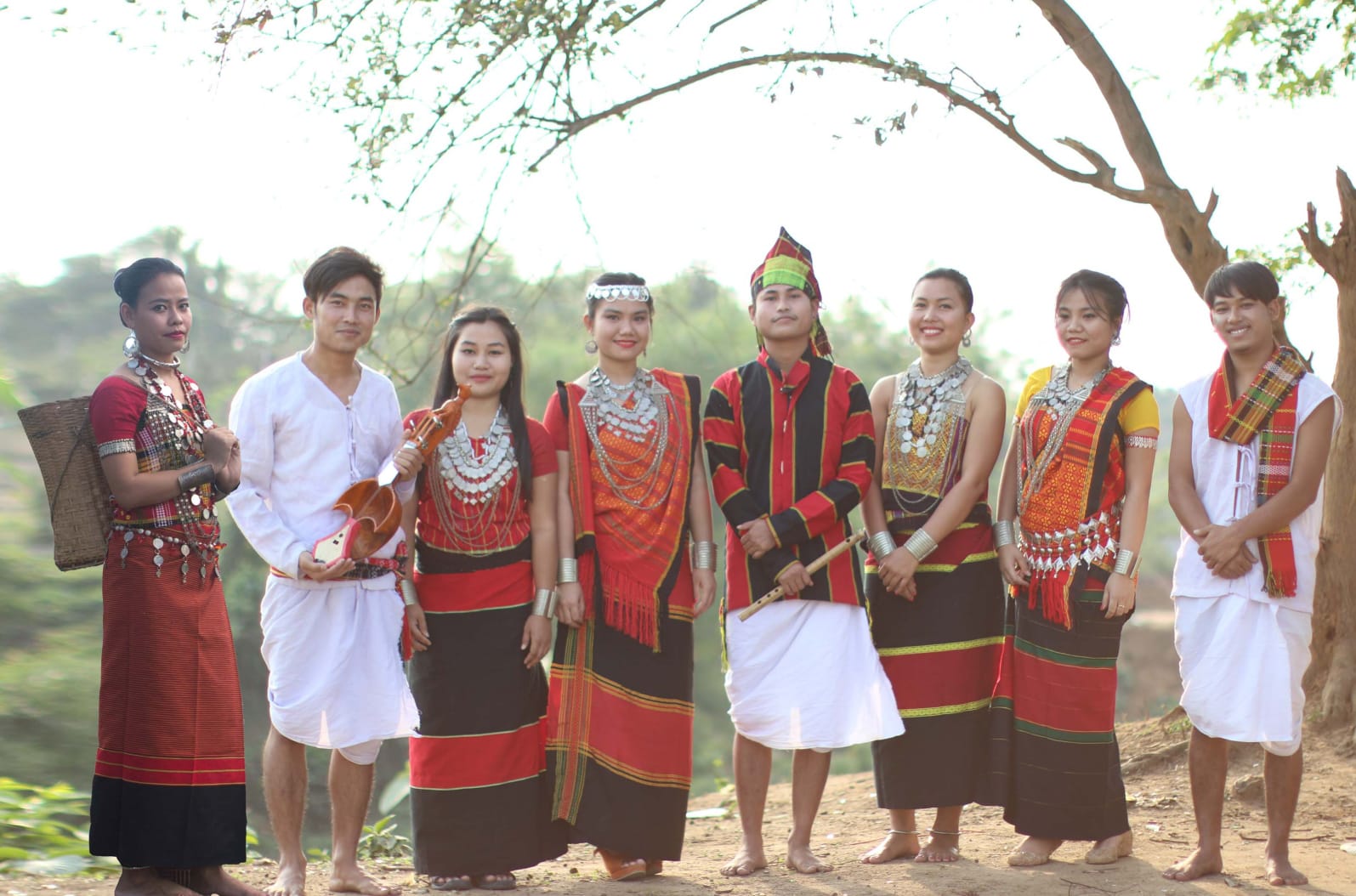
The Tripura Tribe is an ancient tribe & one of the richest tribe in the Indian subcontinent with rich language, history, traditions, culture and heritage. Apart from Tripura, a border state in the North-Eastern region of India, Tripura people also live in other countries around the world. They live in Assam (Hailakandi, Karimganj, Cachar and Dima Hasao districts), Mizoram (Mamit, Lawngtlai and Kolasib districts), different districts of neighboring Bangladesh, and in the Arakan and Chin states of Myanmar. Tripura people are also found in some parts of Australia, French, Thailand and Nepal.
The Tripuras speak in Tripura language, which is their mother tongue. Tripura language is a very ancient and rich language in terms of vocabulary and grammar. Historically, the language belongs to the Sino-Tibetan language family and more specifically, Tibeto-Burman Family, Bodo Group (Sir G.A Grierson, 1903, Linguistic Survey of India, Vol-III, Part-II, TIPURA). The sister languages of Tripura language are Dimasa, Bodo, Tiwa, Hajong, Kachari, Garo etc.
Tripura state is a small hilly & princly state in the North-Eastern part of India, but it is populated by people of different languages regardless of caste, religion. The unity in diversity is not the final word here since there are numerous festivals throughout the year. At nearly every instant some segment of the state is under the influence of the scent of festivals. Socio-cultural and religious festivals predominantly revolving around Bengali and Indigenous people are celebrated in the state. The socio-cultural and religious festivals of all these ethnic groups of the state support one another and carry messages of peace and happiness. A few such universally celebrated or observed festivals among the indigenous people of Tripura state are Buisu festival, Goriya festival, Kharchi festival, Ker festival, Hojagiri festival, Sangrai festival, Wangala festival etc.
Out of them, Buisu is the main festival and historical essence of the Tripura tribe and one of the most popular festivals in the State of Tripura. Buisu is one of the ancient Tripura festival celebrated with lot of joy enthusiasm in every Tripura household. The Government of Tripura and Government of TTAADC have also declared a holiday on the occasion of Buisu festival. This Buisu festival is celebrated on the last two days of Bengali year i.e. the last two days of the month of Chaitra and the first day of the month of Baishakh. The first day of Buisu is known as Haribuisu, the second day as Buisuma and the third day as Bisikatal (Atadak).
It is on this day that the Tripura people observes the Buisu festival, the Chakma people celebrate the Biju festival, the Marma/Mog people celebrate the Sangrai festival, the Assamese people celebrate the Bihu festival, the Boro people celebrate the Bwisagu festival, the Rabha people celebrate the Baisakhu festival, the Tiwa people celebrate the Bisu festival, the Dimasa people celebrate the Busu festival, the Karbis celebrate the Johang festival, the Hajong celebrate the Chorkhela or Chormaga, the Manipuris celebrate Cheiraoba festival. The festival is performed in some parts of Thailand, Mynmar, Indonesia in other names and different forms (Spring Festival). So it is an international festival for all reasons. In fact, it is a festival of Mongolian people belonging to Tibeto-Burman group.
Buisu Festival is not just a social festival, but there is evidence from history that it is also celebrated as one of the New Year’s festival of Tripura people. It is known from ‘My Journey To India’ (Page 120) by Mr. Robert Collins in 1837 AD. He wrote— “Hilly Tipperah was Sonorous in the middle part of April and its people were very merry making, singing and dancing to observe their great new year festival. They were to much homely and pleasures I never witness……..”.
While celebrating the Buisu festival, the Tripura people need to abide by some social norms and principles observed since the early days of the creator Dangaima-Dangaipha. Some of the norms and principles implemented in traditional Buisu of the early days are concisely pointed out –
On the first day of Buisu i.e. Haribuisu day, there are certain traditions to be performed by the society like on that day young boys and girls wake up in the morning to collect garden flowers. With those flowers, lovely flower garlands are prepared to adorn the house, shrine of house. In the morning Kaisleng/Chemai tours around the village with some paddy and sprinkles the paddy to ducks, roosters, chickens. Domestic animals such as cows, goats, buffaloes etc. are let out early in the morning. Then boys and girls dress up in new clothes and go from house to house along with their friends. Boys and girls are served auan or pitha from house to house. Consuming auan on Buisu day is a social practice of Tripura people. On this day, people go from house to house in the village and enjoy the festivities. Thus, the whole society of Tripura is high on joy focused around Haribuisu.
On Haribuisu day, every member of the family must bathe applying Kuchaitwi or Chakhwitwi over their bodies. Then each and every corner of the dwelling house decorated with a lamp and sprinkled with ‘Kauantwi’ and is Kathar or sanctified. Bathing with Kuchaitwi or Chakhwitwi is an old tradition on of the Tripura society.
If we tell in more detail about Buisu, it can be understood that one day prior to Haribaisu, the Tripura girls used to go into the forest in groups with da (a knife) and nokhai/kwbang (a traditional basket). There, a kind of wild leaf named ‘Lairu’ (Phrynium placentarium) was gathered in order to prepare auan or pitha. A day prior to Haribuisu, the neighborhood youths would gather to grind mamirong (sticky rice) in a dingi or morter and prepare that lairu leaf to produce all kinds of auans or pithas. Today, Maimirong (sticky rice) is practically non-existent in the majority of Tripura homes. And the traditional dingi or morter of is not kept in the yard any more. In the past, the noise of the young men and women of the village pounding the sticky paddy together on the eve of Buisu would have awakened the villagers from sleep early in the morning, but now they don’t hear that sound anymore. All they hear the sound of that engine revving Rice mill. Banana leaves from the garden are used in place of ‘lairu’ leaves for the preparation of traditional auan.
On Haribuisu day, Kherebai bodols would venture out to dance the Kherebai dance in other villages. But one thing is to be noted that the Kherebai Bodols have to return to their village within three days i.e. Atadak (Bisikatal) day according to the societal customs. If due to any reason he can’t return back to his village within three days, then they can dance Kherebai by visiting village after village within seven days at max. Anyway, Haribuisu day was celebrated by everybody in this manner.
The second day of Buisu is referred to as Buisuma. During the day of Buisuma, people of Tripura adorn their homes with different kinds lovely flowers and leaves. The domestic cows, buffaloes are worshiped by garlanding them and by satrai (incense) burning. Duck, rooster, hen, dog etc. animals are given a lot of food frequently so that they don’t run short of food during the new year. On the day of Buisuma, the women of the village take a bath and perform ‘Khumbokmani’ or flower worshipping, and in the afternoon, the clothing’s made by themselves like rinai-risa, ritrak, jolaribatop etc. are dried in the sun. Before sunset, the clothes are again collected and put in Khutru/Rikwbang (a traditional basket used to hold and store clothes). Through this new-brides or women shows off how many cloths they have woven during the current year with evidence. On that day, the distant relatives used to go to one another’s homes. The newly married pairs used to go to the home of in-laws with Maimi-auan, Chok-maikham. Maimi-auan refers to various types of auan or pithas made from sticky rice and Chok-maikham refers to a locally produced alcoholic beverage. The elderly relatives of the in-laws’ clan used to receive their obeisances and bless them with happiness and peace. Married children used to bathe their parents, grandparents, and bow with flowers, satrai (incense) on their feet. On Buisuma day, all households prepare a curry known as ‘Pachon’ according to their ability. It is consumed along with auan. In the past, this delicious ‘Pachon’ curry was coocked with 108 types of green vegetables.
The third day of Buisu is called Bisikatal (Atadak). Bisikatal (Atadak) is known as the new year of the Tripura Era/Tripurabda. It is also known as ‘Tring’. ‘Tring’ is just the short abbreviation of Tripurabda/Tripura Era. It is known from various rare royal documents of the Maharaja of Tripura that the first day of the month of Baishakh was counted as Tripura Era/Tripurabda. The Tripura people have been celebrating the first day of the month of Baisakh as Bisikatal or New Year’s eve from me immemorial.
Based on the facts stated on page 197 of ‘Shri Shri Rajmala’ by Pandit Kali Prasanna Vidyabhushan, we can learn that Tripura’s 118th Maharaja Jujarupha alias Hamtorpha coined a term of its own in the Tripura Era named ‘Tripurabda’ to celebrate the victory over some parts of Bongodesh in the year 590 AD. The Tripura Era has been in continuous use since 590 AD. Next 15 April 2025 or first day of the month of Baishakh will be 1435 Tripurabda/Tripura Era.
But unfortunately, some years back in 1991 few mislead minded wanted to shift Tripurabda/Tripura Era and re-write the history of Tripura Era in synchronization with particular religion Era. In doing so they selected 22nd December, which is an imaginary date, wrongly chosen and suggested by some group without having any historical evidence, suggesting to shift Tripurabda/Tripura Era calendar on a very casual manner. As before 1991, there’s no existence of 22nd December in the Tripura Era.
On the New Year day all people rests. No member of the family works in other’s home. On this day, all people, both rich and poor, arrange a special meal as per their affordability. On this day, as per the social traditions of the Tripura Nation, ‘Katharak’, ‘Chumlai’, ‘Longdrai’ are worshiped by sacrificing rooster, goat, pig for family prosperity and happiness.
The major attract on of Buisu festival is the Kherebai. The dance performed based on the Goriya deity is called ‘Kherebai Dance’. The song performed to the rhythm of ‘Kherebai dance’ is called ‘Kherebai Rachapmwng/Kherebai song. Kherebai dance is mainly performed in backyards and village to village during Buisu Festival. Kherebai dance is referred to as a well-known dance of Tripura Nation. One has to dance the Kherebai dance in one’s village anyway on Bisikatal day. There are some social norms to be adhered to in dancing Kherebai dance from village to village. It is obligatory for all to abide by the rules. Kherebai Bodols enter the village in a procession playing kham/madwng (drum) and singing Kherebai songs. Depending upon the social status, Kherebai is performed in the courtyards of the Naran (The Chieftain of Tripura Society), Pomang (Head of the Tripura Moyal/Region), Taimang (Assistant to Pomang) and Roaja (Head of the Tripura Village). Then, they performed the Kherebai dance by going from one house to another in the village. This popular Kherebai song is given below—
Phaibaidi phaibaidi
Goriya masanai
Para para berainai
Nokbwi-nokbwi masanai
Goriyani charairok, Goriyani brwirok
Lachi kiri ta ongdi
Lachi kiri ongkhlai
Goriyano manedi, Goriyano khulungdi
Oire Goriya, oire Goriya.
Machayani chwng phaiya
Malwngyani chwng phaiya
Buisunise chwng phaiywk
Khalinise chwng phaiywk
Roajano asagwi Goriyase phaibele
Hatung haua rekegwi
Twibuk twisa basogwi
Goriyase phaibele
Goriyano manedi, Goriyano khulungdi
Maiba-khuba barenai
Rangchak- ruphai nok pwngnai
Oire Goriya, oire Goriya
Sualming sualming....
E ho ho ho ho ho.........
In order to attract the audience to the Kherebai dance, some catchy and mocking songs are performed to the rhythm of Kherebai dance-songs. Suck mocking songs performed during the Kherebai dance are called ‘Kokphakra’, some of them are given below—
1.
Thaichumu thaiywk thaiywk
Dormai thaiywk thaiywk,
Saka parani brwisaroklai
Kama naikhlai khiywk.
2.
Huchung koreni mwiya
Huchung koreni mwiya,
Chini parani siklaroklai
Rinai khlongna chukya.
3.
Yagra naidi naidi
Yaksi naidi naidi,
O parani brwisarokno
Mwtwng sugoi rodi.
4.
Gati khamani holong
Gati khamani holong,
O parani brwisarokni
Rinaise glong-glong.
5.
Haba skangni khaklu maitwk
Tankhogoi chapaiya,
Brwima masa tormani bagoi
Mwtwng sutokya.
6.
Bisi ktalni uatwi uamani
Ahbsa kwchang khade
Siklasani uaisa manjakma
Jom jom ongkhade!
7.
Danga thangmani uathwide uathwi
Danga thangmani uathwi,
O parago phaiyoi nuphaima
Brwirok mwkhang kwthwi.
(8)
Mtai romani uathop
Mtai romani uathop,
Chini parani siklaroklai
Okse petok- petok.
The Buisu is meaningless without Goriya. The Buisu celebrated with pomp-and gaity because of Goriya. Through Goriya Festival a tale of external love and sensation being expressed which has come through tradition down to present time, since time immemorial. A Tripura cannot worship any other god or goddess before worshiping Goriya. Goriya is not only a ruling deity but a supreme deity as well.
The social tradition or customary laws followed by the society of Tripura Tribe since the period unknown mentioned above is nearly lost nowadays. Now-a-days the urban people of Tripura except in villages and hills have never experience so much festive joy surrounding Buisu. Nevertheless, Buisu festival is celebrated every year state level by Tripura Chubalai Buthu as the core social festival of Tripura people and a social festival of Tripura state. This year the 23rd State Level Buisu festival is to be held at Basi Chandra Para English Medium Higher Secondary School ground in Korbook sub-division, Gomti District of Tripura State. Tripura people will present different kinds of art and culture in this state level Buisu festival for two days on 12-13 April. And thus, the whole Tripura village-hills and Tripura Tribe become joyful with the happiness of Buisu festival.
Refference:
- Tripura, Dharinjoy, ‘Tripura Jatir Porichiti’, April 2018, Tripura Chubalai Buthu, Central Committee, Agartala, Tripura.
- Tripura, Dharinjoy, ‘Prasangik Tripura Jatir Bhasha, Songskriti o Eitirjya’, April 2019, Tripura Chubalai Buthu, Central Committee, Agartala, Tripura.
- Tripura, Dharinjoy, ‘Tripura Jatir Bhasha o Songskritir Songkshipta Ruprekha’, 2023, Penstar Publications, Agartala, ISBN: 978-81-962122-7-8.
- Tripura, Dharinjoy, ‘Buisu-Biju Porober Anonde Motoyara Samagra Tripura Gram Pahar’, Sandan Patrika, 6 April 2017, Agartala.
- Tripura, Dharinjoy, ‘Buisu Utsav Niye Kichhu Kotha’, Noyong, January 2023, Bangladesh Tripura Kalyan Songsad, Bandarban, Bangladesh.
- Tripura, Shyama Charan, ‘Goria- A Festival of Excellence’, Goria, Souvenir of Goria Festival, 29th-30th April, 2006, Tribal Research & Cultural Institute, Government of Tripura
- Tripura, Dharinjoy, ‘Tripura Jati o Buisu Utsav’, Goriya, Souvenir of Goriya Hukumu Ter-2016, TUKS, 19 April 2016, Agartala.