

By Gautam Sarmah
Once again, the king of seasons, spring, arrives upon the bosom of the earth. With its advent, trees and creepers reaffirm the eternal laws of nature and adorn themselves with a fresh attire. The Bihuwati bird too descends to the plains, singing sweet songs in its melodious voice. Spring brings to nature a message of peace, harmony, and progress. Its gentle touch nurtures bonds of unity, solidarity, and brotherhood among human hearts. The presence of spring seems to dispel social violence and unrest, shaping a green earth and a clear sky. Inspired by its softness, poets and lyricists compose new songs and verses. The green world, in the arrival of spring, assumes such unparalleled beauty that it defies all comparison. The very thought of spring brings to mind the beloved Bohag Bihu, deeply cherished by every Assamese, where there is nothing but joy and celebration. Hidden within the heart of spring, Bohag Bihu carries a glorious history of its own.
Though Bihu originated and evolved from traditional agrarian life and the common people, in recent times this vital cultural spirit of the Assamese seems to have taken a new form amid waves of change and transformation. Alongside positive developments, many negative practices have gradually increased, bringing disrepute to Bohag. A close look into history reveals that Bihu was essentially a festival of agrarian and laboring communities. It embodied the raw fragrance of life, youth, and nature, a fragrance that once filled the earth with vitality. But does that Bihu, with all its original characteristics, still exist today?
Bihu is not an exclusive festival of Assamese speakers alone. It is a collective national festival of the indigenous communities of Assam and the wider Northeast. Rooted in Austro Mongoloid fertility beliefs and enriched with elements of Aryan and Dravidian cultures, the three Bihus reflect a harmonious synthesis. Festivals across India such as Baisakhi, Pongal, and various Sankranti observances, along with celebrations of different ethnic groups like Bihu of the Chakmas, Poihu of the Tai Ahoms, Tusu and Karam of tea tribes, and numerous others among Karbis, Garos, Rabhas, and more, all contribute to a composite cultural heritage. Bihu, as a shared cultural asset of Northeast India, still retains many of its ancient features while adapting to changing times and remaining closely linked with everyday life. Viewed broadly, Bihu encompasses a wide range of traditions including rituals, beliefs, food practices, ornaments, musical instruments, dance, songs, and performing arts such as Bihu songs and Husori, all of which today appear in a blended and integrated form rather than in isolated purity.
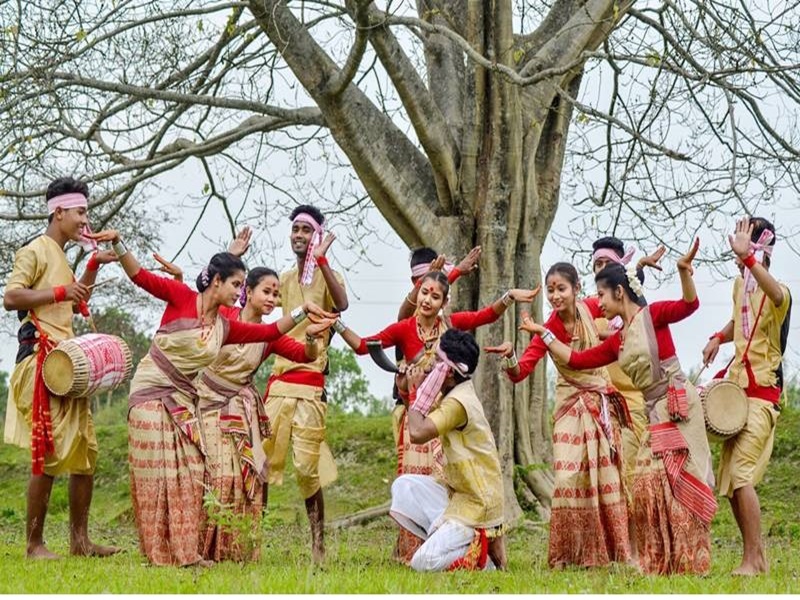
Assam, rich in evergreen natural beauty and abundant resources, stands as a unique land of vibrant folk culture and tradition. With the arrival of spring, the earth becomes ever youthful. In earlier times, under the shade of trees, on riverbanks, in courtyards, and in open fields, Assamese youth would spontaneously sing and dance Bihu songs with unrestrained joy. Their bodies, minds, and souls would resonate with the rhythm. The melodies of Bihu songs would touch every heart, while the footsteps of dancers would make the earth tremble. In villages, Husori performances would fill the surroundings with energy, accompanied by blessings for the well being of households, livestock, and agriculture. These practices enriched Assamese life with deep rooted traditions and beliefs. However, with rapid change, Bihu has now entered modern competitive stages before audiences and judges. As a result, the meaningful essence and traditional purity of Bihu seem to have been affected under the glare of decorated stages.
Folk dances and cultural wealth, rich in diversity, cannot truly be divided or artificially altered. If that were possible, even timeless architectural symbols like Rang Ghar or Talatal Ghar could have been repainted into modern forms. The folk culture of a community reflects its refined consciousness and identity. Bihu, enriched with vibrant elements, is the lifeblood of Assamese national life. Today, its spread has crossed regional boundaries and reached international recognition, which is a matter of pride. Yet, at the same time, certain emerging trends in its celebration raise concerns.
Celebrating Bihu on grand modern stages with large advertisements and banners does not necessarily represent the true spirit of the culture. Instead, recreating the authentic village environment would make Bihu more meaningful and attractive. Many traditional elements closely tied to agriculture such as ploughs, tools, bamboo artifacts, weaving looms, and rural practices are gradually becoming unfamiliar to the younger generation. Without the earth, open fields, trees, and natural surroundings, Bihu can never be complete. Its essence lies in the deep relationship between land and farmers. Without the scent of soil, the touch of mud and water, and the charm of nature, the true intoxication of Bohag cannot be experienced. The genuine and unadulterated bond between earth and cultivation forms the core meaning of Bihu.
Under the harsh impact of time, Bihu is increasingly turning into a commodity for buying and selling. The number of people engaging in its commercialization continues to grow, distancing the agrarian and working communities from its spontaneous joy. Traditional practices associated with Bihu are gradually fading. The simple celebrations once held under trees, by riversides, and in open spaces have now been replaced by expensive stages and organized events. Even in villages, the original charm of Bihu is rarely seen. Husori groups often choose households based on financial status, limiting participation of common people. Today, performing Bihu often requires expensive costumes, excluding many traditional dancers. Treating Bihu as a commercial product while ignoring its foundational elements is deeply unfortunate. Bihu is not the private property of anyone but a shared cultural heritage, and every Assamese has equal claim over it. Therefore, organizing Bihu indiscriminately while neglecting its traditions undermines its authenticity and legacy.
Although human customs and traditions have changed, the beauty and rhythm of nature remain constant. Even today, with the arrival of spring, new leaves sprout, flowers bloom, and birds announce the season, preserving the essence of Bohag. Yet, as rational beings, we have often, in the name of change, diminished the beauty and sweetness of this tradition. It is important to remember that cultural refinement is necessary, but not at the cost of damaging the core elements of folk culture. Any attempt to reform or transform Bihu by discarding its traditional foundations is inappropriate. If these age old elements and unique characteristics are abandoned, this rich cultural stream may soon fade into oblivion.
(The Author is a Faculty Member of History in Rabindranath Thakur Vishwavidyalaya, Hojai, Assam.)