
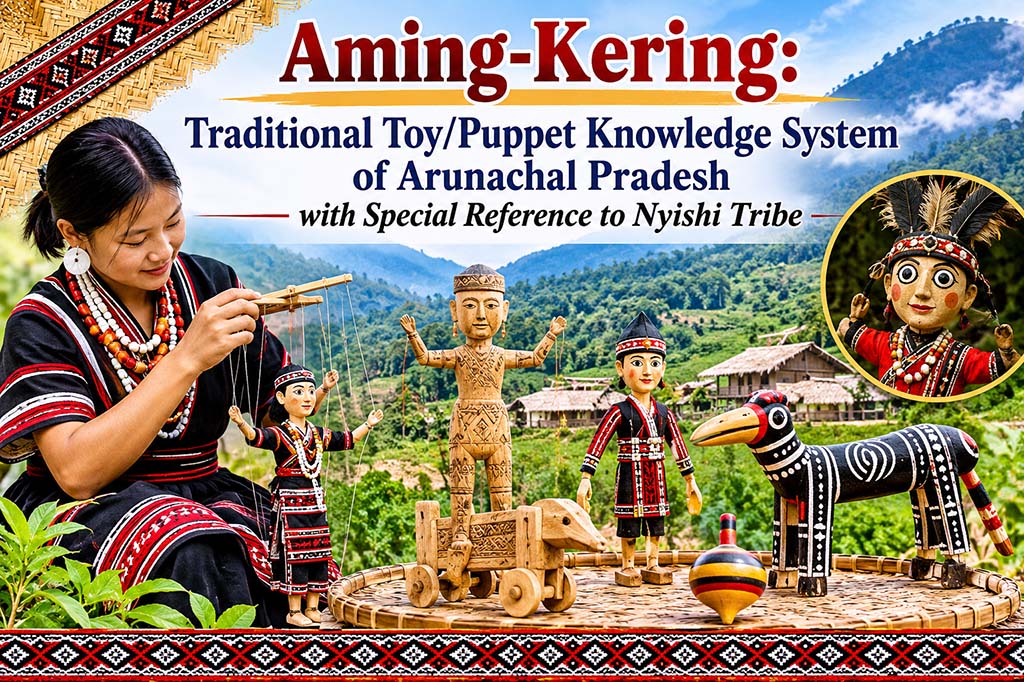


By Dr. Joram Aniya & Dr. Robin Hissang
Introduction
The Nyishi, a principal tribe of Arunachal Pradesh have its own faith and belief system which regulate everyday life since time immemorial. The name of religion of the Nyishi tribe is known as Donyi poloism in which beliefs both Donyi and Polo play vital roles. The Nyishi considers Donyi (Sun) as Ane Donyi (mother Sun) and Polo (Moon) as Abo Polo (Father Moon). The Nyishis is the largest groups (in terms of number as per 2011 census) There are 4,42,000 population based on 2024 census. They inhabits in 8 districts namely East Kameng, Papumpare, Kurungkumey, Kra Dadi, Kamle, Pakkekessang, Lower Subansiri, Upper Subansiri, West Kameng, some parts of Sonitpur and North Lakhimpur district of Assam. Some scholars perceive Nyishias individualistic in nature; it might be after observing their complete independent oriented behaviors .In actual, they are freedom lovers people, not submitted their independents characters and freedom before any rulers so easily, so no colonizers, even Ahoms and British, could not succeeded to rule over them (Nyishi) under their colonialism. Their men folk wear hair long and tie it in a knot just above the forehead. They wear cane bands around the waist. They believe that after death the spirit of a dead travels to the village of the ancestors. The basic unit of the Nyishi is the household which comprises of a number of related families in a clan. Each clan consists of a few lineages or groups of men and women tracing or claiming descent in the patrilineal line from a common ancestor because of its patriarchy society. The member of the same clan considers themselves as brothers and sisters by following rule of clan exogamy. They are divided into innumerable clans, who maintains among themselves an oligarchic form of government and each accepts the authority of its own clan’s head which sometimes comprise as much as thirty or fourty in a single clan. His loyalties, at most, extend to his own clan. The bondage of kinship holds clan solidarity and is the basis of their cohesion and unity.
The nomenclature Nyishi is derived from two words “Nyi+Shi”, Nyi means “man or human being” and “Shi” means “being” or “higher region” or “highlands”. Accordingly, the Nyishis means ‘Human Being’ or people living at highland regions. The Nyihsi name for northern region or its people is ‘Nyema’ and the plain region or their plains neighbors are called ‘Nyepak’. So, Nyishi means inhabitants between the Nyema and Nyepak”. The Nyishi tribe belongs to Mongoloid stock and Tibeto-Burman speaker.
The Nyishi tribe inhabits in eight districts of Arunachal Pradesh having population of around four lakhs twenty thousands (4, 20,000) only. The Nyishi speaks Tibeto-Burman language group and belongs to Tibeto-Mongoloid racial stock. As per shaman recitation and hymns, the Nyishitribe of Arunachal Pradesh tribe have own civilisation with beautiful rich heritage and culture. The universe was created millions and millions of years ago from stage of Great Nothingness which is called Jimi-Jama, Mimi-Mama period. In those periods, there was no beginning, no end, no light, no day, no sound, no time, and no life was existence. After that, two stages created, the first one is Kolo stage in where the non-living things like landmass, mountains, rocks, soil etc, river evolved but no movements of those things which is called Kolo Jimi-Kolo Jama, the second stage is called Korium, in this stage there was agaseous form of landmass or gaseous mass but again no life, no sound, no day, no night, no beginning, no end etc. In those periods, there was no separation of Earth (Siichi), sky (Nyodo), others planets and celestial bodies. But, slowly and gradually earth, sky and others bodies were separated in jelly like shape called Chiite Rulum and Dotey Rwlla stages. But, life did not appear till this stage and the new most vital element appeared called Sungsung-Sassa (coming of oxygen and air stage) which started blowing then the vision of all appeared and when the sunlight began to appear called Ujjing Dola Jangap and the air started blowing called Hoja Pada Miqp, the solidity of the earth was formed by a separation of land in the shape of valleys, hills, and mountains and water in the form of rivers, lakes, and seas; life started appearing on the earth. This stage is called Chiitey-Chigar Garlin and Dotay Dogar Garling in which all living and non-living thing life started moving. Accordingly, two important stages Kolo and Kurium the two original non-living and living things stages started counting. So, it is summarized that the stage Kolois identified as the period of non-living andthe actual living-thing procreated in the Korium stage. As per shamanism chanting and ancestral belief, Kolo Dardang Ga Sawang-Kuruim Dardang Ga Sawang (living creature germinated from lake of living and non-living stage). So, it is narrated that Kurium Ramni Ga Tanyi the first ancestral father originated from Kurium stage. After coming of all living creatures on Changte aanv (mother earth) than all living creatures fully procreated including all human being. The creation of universe and origin of living thing is properly narrated through oral literature but now the Nyishi intellectual is in the process of written literature from the oral literature stage. To understand the folklore about Nyishi tribe’s AmingKering the toys or puppet making culture and its historical cultural background is the main objective of this paper.
Methodology
The area of study is the East Kameng district of Arunachal Pradesh, India where Nyishi is one of the principal tribes and taken it as sample of this paper. The study was done on the basis of the data collected from the primary sources like taking interviews and accessed original data. The researcher accessed secondary sources too like published and unpublished documents. The electronic tools were also used for collection of information. The study is empirical in nature and researcher conducted field study and personal interview was taken too with few shamans, priests, Gaon Burahs, and village elders.
History of Aming-Kering (Toy/Puppet Making)
The Aane Donyi (supreme goddess) have different forms with re-incarnation power. She is presented her in three forms in the whole civilization namely Ajjang Jangtey Ne Donyi (Goddess of greatest and supreme), Nyikam Donyi (physical form of sun who gives light and energy to universe) and human form is Donyi Bijine/Jaangtey aanv who became wife Abo Tanyi after incarnated as beautiful lady.
In the beginning of civilization, during Changyang Namchang (the name of dwelling stage) period, the name of Abo Tanyi was known as Niyang Tanyi and Niyang Abo Tanyi married Sachang Changyang ne Tamang (girl name).His wife Changyang Tamang Ne was hard working and laborious lady; she was perfect woman and guided Abo Tanyi properly thereby led good and prosperous life. Both were leading good life with available rice and granary.So, she was synonym with goddess of good harvesting and good producer of rice and other crops. One day Abo Tanyi was roaming in jungle and seen a beautiful lady collecting forests productions like vegetable leafs and other. Abo Tanyi felt in love to that lady. He was impressed by her beautiful cheek and beautiful body. He asked, why you are collecting jungle leafs. She replied that, “I am collecting for my house vegetables and I eats jungle leafs only to survive”. Abo Tanyi said, “How a beautiful lady can survive with eating jungle leafs only. I want to marry you I have countless Aam Nassung (rice granary house) and Abo Tanyi asked, what is your name?”She replied, “I am Dwri (Deri) Ne Yadi‘the goddess of hunger. I can eat one Amm Nassung (paddy grain house) in single night. So, you will regret later on if you marry me”. The Abo Tanyi replied, don’t worry, you cannot finish my rice and grain. After continue meeting for almost a week Abo Tanyi and Deri Ne Yadi had close relationship. Buthis wife Changyang Ne Tamang came to know the relationship and advised her husband Abo Tanyi that our family is now well establishedafter so manyhandwork and dedications. If you marry Deri Ne Yadi; you will ruin your life. Because, she is Goddess of Hunger and she will continue eat our rice and grain till she finish all Amm Nassung. She would not stop. So, listen my advice and do not visit her place from today onwards but Abo Tanyi did not listen her suggestions. He continuously visited Deri Ne Yadi and later on married her. Moment she married Abo Tanyi she started eating Abo Tani rice house continuously without doing any works. Within a month all rice and grain finished. Abo Tanyi again became poor and starting facing problem of eating rice. Abo Tanyi got frustrated and got angry on Deri Ne Yadi after complete ruined and poverty. He started thinking how could she ate the entire countless rice nassung house and even all the grains. He decided to check her stomach by killing her. One day, Abo Tani killed her with his sharpest machete to Deri Ne Yadi and cut her belly to check where all rice and other food grains stored. How a normal lady can eat so much of rice and other grains. Moments Abo Tani chopped up her stomach thenlarge number of small birds called Padang and Papik (small size birds usually eats rice and other paddy in field called maya bird) started flying from her stomach. While chopping up, Deri Ne Yadi told Abo Tanyi, my children i.e. Padang and Papik will continue eat your rice and other grain in your agriculture field even you store then also my children will eat. So, still Padang and Papik eat rice and paddy in the field. The Abo Tanyi’s wife, Changyang Ne Tamang too out of frustration and angry left him too. Abo Tanyi became poverty and his life ruined. He started roaming in search re-establish his life. At last, Abo Tanyi married Donyi Bijine after winning so many competitions to all male deities and life started re-shapes and his agricultural field too started flourishing as earlier but Padang and Papik birds eaten all paddy before harvesting. Again Abo Tanyi got frustrated then at last he asked Donyi Bijine for solutions to prevent the menace otherwise possibility of hunger and poverty may come. Then Donyi Bijine told him, that “all these are because of your past mischievous activities and past sin which haunting you. All these birds are your children and curse of Deri Ne Yadi whom you killed after making her as your wife despite my advised not to marry her.So, you cannot kill these birds if you kill then also their number will multiply and haunts you even may cause your destruction”. Then Abo Tanyi expressed regrets and realized for his disobeying wife’s right guidance but asked her for solutions. Donyi Bijine was human form of Ajwng Jangte Aanv (Supreme goddess Sun) to show the right and wrong, moral and immoral, ethical and unethical attitudes to Abo Tanyi so that descendents of him can follow and set peaceful atmosphere in the society following the customs. At last, Donyi Bijine told the solutions that in order to prevent Padang and Papik from damaging paddy in the agriculture farm. Abo Tanyi need to develop puppet system which need to look like male human being and need to keep that male like puppet in standing pose in the middle of the field with bow, arrow and holding of machete so that Padang and Papik can misread it as Abo Tanyi in ready position to harm us if eats rice, paddy and other grains of the farm. Abo Tanyi followed all instructions of his wife and did same. Then the Aming-Marangnam (puppet) of Abo Tanyi was placed in all corners of his agricultural farm then onwards Padang and Papik stop damaging the crops of Abo Tanyi. Then onwards, Abo Tanyi got the idea of Aming-Marangnam (Puppet) after followed the valuable instructions of Ane Bjine and started making various form of puppet in order to use that puppet in different purposes in the Nyishi society. Since onwards, use in Nyishi maxims, “Abo Tanyi Nho Ane Bjine ga bingna hm tarang taage leno, rorang hm kungge leno ngulu Nihakaosi, Ngulu Nyishi Si aming-marang dna” which means father Tanyi and mother Bijine’s valuable verses, followed the idea of actions, we descendents of Niha, we Nyishi still make puppet”.
Henceforth, still Nyishi society has various form of puppet making system. The important types of puppet making system in Nyishi community are follows:-
Nyi Aming-Marangnam (Human Toy/Puppet)
The Nyi means human and aming-marangnam means toy/puppet. This is human toy/puppet which make to put in granary house, outside the house or in agricultural farm so that theft, strangers, animals and birds can be chased away from ill intention activities in the house or farm premises.
Papuk Aming-Mrangnam (Banana flowers Toys Making)
The Papuk are use as fruits, vegetable and puppet making in Nyishi society. Before giving fruits, the flowering part of Banana is called as Papuk. From Papuk, it is making as animal puppet like mithun, goat, pig etc. for children to use as during day time. In olden days, the parents used to go to field and to do other agricultural activities. In house, they give them Papuk to make toys or puppet so that they can play with them thereby engages them busy in playing with Papuk puppet.
Ako Aming-Marangnam (Leaf puppet/Toy Making)
This bamboo leaf toy/puppet making like birds, dog or house make from dried bamboo leaf and usually make for children to play.
Assang Aming-Marangnam (Stick Puppet/Toy)
This is toy making from small dry sticks with wrapping from cloths in young girl and boy form. The artificial beads and other ornaments are being decorated with girl and mock display about traditional wedding ceremony of the community.
Conclusion
There are lots of changes have taken in the process of modernization and globalization, in Nyishi socio-cultural and political life too, many changes have come up. In earlier days, there was not proper technology thereby toy/puppet making can not continue and due to non availability of marketing scope. The popularity of toy making system in Nyishi society diminishing which need to revive by taking the helps from government and other stakeholders.In order to promote, systematization, documentation and formalization of old age Nyishi oral tradition and culture. The Nyubu Nyegam Yerko (indigenous Tribal education institution has been established at Rang village in 2020 under East Kamng district in where the toys making process has been introduced as part of school curriculum activities.
The Yerko is similar to ancient Gurukul model education system developed in ancient to modern India which is totally residential and all kind of teaching-learning is being imparted with teachers staying with students inside the yerko’s campus itself. The yerko is run in joint venture of Donyi Polo Cultural & Charitable Trust with Council for Nyishi Language Research and Training the educational wing of Nyishi Nyidung Mwngjwng Rallung and Vivekananda Kendra Vidhyalaya, Kanyakumari. The CBSE pattern and NCERT syllabus of education is being taught by VKV and Nyishi language teaching learning by Council for Nyishi Language Research and Training. Presently, there are four Yerkos functioning namely Nyubu Nyegam Yerko in Rang under East Kameng with 136 students, Nyubu Nyegam Yerko at Mwya village having 64 students of Nyishi tribe, Menjik Meqkok at Basar of Galo tribe having 69 students and Nilung Tungko of Adi at Pangin with 49 students till 2024-2025 academic session from class I to V standard. All students are selected based from Orphan background, BPL and poor villagers. This school is only hope for preservation and promotion of indigenous knowledge system of toy making in days to come.
References
1. Excerpted from Personal diary based on story narrated by Late Narbo Kocho, the then HGB Rang village on 20th October 2002 at Rang village, East Kameng district,
2. Excerpted from Personal diary based on story narrated by Late Mora Hissang Silla village on 20th January 2003 East Kameng district, Arunachal Pradesh,
3. Nwsw Agam Bengrap Ko Hv (Nyihsi Language Introductory Primer)Rang Kin(part-I) (Textbook for class-I) developed by Council for Nyishi Language Research and Training. Published by DVS Publishers, Guwahati Assam-2020,
4. Nwsw Agam Bengrap Ko Hv, Rang Nyi(part-II) Rumbi Nyi Gabv Lvr Pokum (Textbook for Class-II) developed by Council for Nyishi Language Research and Training. Published by DVS Publishers, Guwahati Assam-2021,
5. Nwsw Agam Bengrap Ko Hv, Rang Um(part-III) Rumbi Um Gabv Lvr Pokum(Textbook for Class-III) developed by Council for Nyishi Language Research and Training. Published by DVS Publishers, Guwahati Assam-2022,
6. Wjiwng LLvllaq, Rumbi Pi Gabv Lvr Pokum(Textbook for Class-IV) developed by Council for Nyishi Language Research and Training. Published by DVS Publishers, Guwahati Assam-2023,
7. Wjiwng LLvllaq, Rumbi Ngv Gabv Lvr Pokum(Textbook for Class-V) developed by Council for Nyishi Language Research and Training. Published by DVS Publishers, Guwahati Assam-2024,
8. Interviewed with Shri HagoTallo President, East Kameng Indigenous Priest Welfare Society on 21/08/2024 in Seppa,
9. Taken Interview to Shri Niti Sengdo, famous priest cum GB Silla village East Kameng district,
10. Interview with Shri Deraka Sangdo, Priest of Donyi Polo Nyedar Namlo, Seppa,
11. Interview with Shri Biro Langdo, priest cum HGB Silla village East Kameng district, AP.
12. Dr. Hissang Robin: “The Narba Chanam System as Source of Oral Literature of Arunachal Pradesh with Special Reference to Nyishi Tribe of East Kameng”, Heritage Explorer, A Monthly Magazine, Volume-XXIII, No.8 August 2024,
13. Dr. Nabam Tata,(2019) Nyetam, Cvgar Dogar Garnam: Evolution of Earth and Universe, published by Raywngyirkum Pwqlwng Nyedar Namlo, Doimukh Arunachal Pradesh,
14. Prof. Showren Tana,(2009) The Nyishi of Arunachal Pradesh, An Ethno historical Study, Regency Publications, Delhi.
15. Dr. N. N. Hina, 2012, Customary Laws of Nyishi Tribe of Arunachal Pradesh, Authors press Global Network, Marketed by Jawahar Park, Laxmi Nagar, Delhi.
16. Dr. Joram Aniya, 2023, Nyishi Lok Sahitya, Hindi Kendra Sanstahn, Agra, Uttar Pradesh under Govt. of India.
(Dr Joram Aniya, Member, NITI Aayog & Dr. Robin Hissang, Founder Principal, Govt. College, Seppa, Arunachal Pradesh, He can be reached at Email ID: robinhissang@gmail.com & Mobile no.8131887134 )