

By Manash K. Das
Veneration, devotion, obeisance…these are but only some of the emotions that the very mention of Maa Kamakhya evokes in the hearts and minds of millions in India and indeed, around the world.
Hinduism, being the oldest religion in the world, dates back several millennia, predating even the Ramayana, and is the foundation on which modern day Indian society has been laid. Sanatan Dharma has many Gods and Goddesses and their numerous avatars. Therefore, it is only to be expected that a religion that old will have countless stories and legends of its Gods and Goddesses.
One such Goddess is Maa Kamakhya, revered by millions around the world and this temple is unrivalled as a place of tantric practice.
Nestled in the Nilachal hills on the banks of the river Brahmaputrain in Guwahati, the Kamakhya temple is considered the most powerful and potent of the fifty one Shakti Peeths. Kamakhya is the yielder of fertility and of all desires. She is both ferocious and benign. She nourishes but can also destroy.
There is no idol of Maa Kamakhya; She is worshipped in the form of a rock fissure in the shape of a Yoni (female reproductive organ) which is located in the Garbhagriha (the sanctum sanctorum) of the temple. A constant and natural stream of water keeps the deity moist at all times. The Yoni is bedecked with sarees, vermillion, red flowers, etc. befitting a goddess. The Garbhagriha is below ground level and is kept nearly dark since it is considered to be the womb of the Goddess.
Ambubachi means “to grow from water” and the yearly Ambubachi mela, spanning four days, is a celebration of the annual menstrual cycle of the Goddess that is synonymous with fertility and procreation. The rains that invariably accompany the mela, is synonymous with the fertility that it provides Mother Earth. But to know and understand the significance and the widespread veneration of Ambubachi one must go back to mythology and recorded history.
There are various legends surrounding the origin of the temple, and the most popular one is as follows: Sati’s (lord Shiva’s wife) father Prajapati Daksha had organised a yagna, to which Sati and Shiva were not invited because Sati had married Shiva despite Daksha’s opposition to the marriage and so, Daksha carried a grudge against them. But Sati desperately wanted to attend the yagna, and despite the forebodings of Shiva Sati went to the yagna that her father was performing. However, on seeing her Daksha started badmouthing and belittling Shiva in the presence of all the residents of Tribhuvan, which was extremely humiliating for Sati. Unable to tolerate such humiliation Sati took her own life at the yagnasthall (place).
When Shiva heard of this tragedy, he was beside himself with grief and rage. He carried Sati’s lifeless body on his shoulders and started doing the Tandav Nritya (the dance of destruction) with such fury that even the Gods were frightened. Lord Vishnu unsuccessfully tried to pacify Shiva. Left with no choice, Vishnu deployed the Sudarshan Chakra and dismembered Sati’s body into fifty one pieces. Each of the places where Devi’s body parts fell is known as Shakti Peeths. Kamakhya is the place where Sati’s Yoni (the female genitalia) fell.
Legend also has it that the temple was originally constructed by Kamdev with the assistance of Vishwakarma. Although, it is an established fact that the present structure of the main temple was built centuries ago, there are however, various theories as to who was behind the construction. Islamic invaders destroyed the temple in either the 15th or 16thcentury. Later, the ruins of the destroyed temple were said to have been discovered during the rule of the Koch Dynastyand that the reconstruction of the temple was completed under them. Worship at Kamakhya resumed during this period. The Ahoms conquered Kamrup in the later part of the 17th century. The Ahomrulers were worshippers of Shiva and Shakti and actively patronised, renovated, rebuilt and maintained the temple.
In the vicinity of the main temple is a complex of individual temples dedicated to the ten Mahavidyas of Shaktism. Tripurasundari, Matangi and Kamala are housed within the main temple whereas the other seven reside in individual temples, including the fervently revered Bogolamukhi temple which is located a little further up the hill.
Kamakhya embodies the mother cult of Shakti (power). Ironically, all the avatars of Shakti are of the female gender. This, in itself,is representative of the respect and high position that women in Bharat have been traditionally accorded. This tradition, among many others, has unfortunately been diluted over the centuries due to the repeated invasion of Bharat by foreign powers, and the corruption they brought with them.
The Ambubachi Mela is the largest religious congregation in north east India and is a major event in the religious calendar of the region and also, for the people of Bengal and even Odisha. It lasts three days and is observed from the seventh to the tenth day during the month of Ahaar (Assamese for Asadh) in the Hindu calendar. It is believed that the guaranteed rain around the time of the mela makes the soil fertile and ready for procreation. The temple is shut to all for those three days, thus affording privacy to the deity. All Hindu places of worship in the region, both public and private, are also shut during this period. Besides this, all agricultural works are also suspended for those three days. Ascetics, widows and others who adhere to the strict code do not consume cooked food during Ambubachi.
Lakhs of devotees throng the Nilachal hill during the days leading upto the mela. The vast majority of visiting devotees - mostly from West Bengal - arrive either by train or by bus. Those who have friends and relatives in Guwahati stay as their guests. Some stay in hotels and other commercial lodgings. Others are accommodated in makeshift camps that are specially constructed for the occasion by the district administration under the Government of Assam, in and around Nilachal hill. The Pandas (priests) at Kamakhya have traditionally provided lodging to visiting devotees in own homes near the temple, and as many as 30,000 guests can stay in these homes. Those who do not find accommodation in any of aforementioned places coup themselves up wherever they can, including the Bhootnath cremation grounds near the Nilachal hill.
With the fame of the Ambubachi mela having spread far and wide, devotees nowadays come from as far as Maharashtra, Rajasthan and Haryana to pay obeisance. Of the ten lakh odd people who visit the temple during the mela, about three lakhs are from outside Assam.
The Sadhus and Sanyasis (ascetics) are a major attraction at the mela. The ascetics include the Naga (nude), Kinnar (eunuch) and Aghora Sadhus. They perform their unique rituals, including tantric rituals, from the first day of the mela. Many people visit Nilachal to observe the ascetics –many of whom sport dreadlocks- and to seek their blessings. Sadhus and the sanyasis are not commonly seen and their presence imparts an air of mystique to the ambience. Many ascetics can be seen in deep meditation, oblivious to the world around them, pointing to a higher consciousness. This higher consciousness is what “Shiva” represents. Those ascetics belonging to different akharas stay in the accommodation that that is arranged for them by their respective akhara. Others pitch a tent wherever they can. Most ascetics house themselves in and around the temple premises.
The common objective of all Sadhus is to attain Moksha - liberation from the cycle of birth and death. Hindu ascetics have devoted their lives to the pursuit spirituality and, unlike the common man, have purged themselves of maya (illusion). Their temper can be mercurial and those who seek to engage in a conversation with them do so very carefully, so as not to invite their ire.
All possible logistical support is provided by the administration. Free of cost shuttle buses are provided from the base of the hill to the temple to transport devotees to and fro the temple. Regular free meals are provided by the district administration. There is no dearth of food, water and refreshments as various philanthropic organisations go out of their way to provide the same to whoever visits the temple during the mela, completely free of cost. The district administration also provides sanitation facilities and free medical camps. The temple management also provides accommodation, food and recruits hundreds of volunteers to maintain cleanliness.
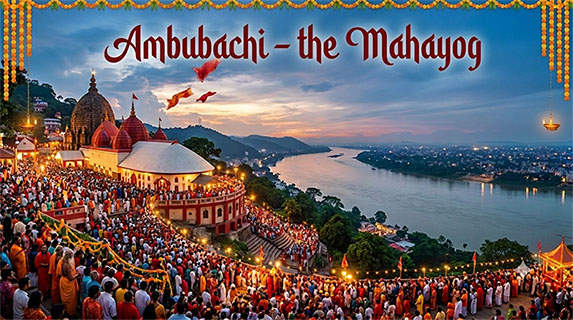
The sheer mass of humanity in and around the temple premises is a sight to behold. The accompanying sounds and the general ambience bespoke the deepest bhakti (devotion) that one can imagine. Paeans in praise of the Goddess, and bhajans (religious songs) reverberate throughout the slopes of Nilachal and over the lapping ripples of the Brahmaputra. The renowned singer, Kailash Kher, has also performed with eager enthusiasm at the mela. All this, along with the inevitable pouring rains rejuvenates the soul and Mother Earth alike. It is not uncommon to see devotees, lost in devotion of Maa Kamakhya, with tears of joy pouring down their cheeks and over smiling lips. The one thought is to soak in the shakti (energy) of the place, for Ambubachi is the time when auspicious time and space coincide on Nilachal hills.
There is a constant rotation in and around the temple premises. Every two or three hours a completely new batch of people arrives to soak in what the earlier batch already had. This, of course, is to engage with, and seek blessing from the ascetics.
The eager anticipation to view the Goddess in Her most potent glory is palpable. This comes to fruition on the fourth of the mela, when the doors of the temple are thrown open for worship. Before the doors are opened the deity is bathed and various rituals are performed by the temple priests.
Prasad is then distributed among the devotees. The Prasad comes in two forms – angodak (water used to bathe the deity) and angabastra (red cloth that the deity is covered with). The angabastra is cut into many small pieces and distributed. Devotees treat the prasad with the utmost veneration, for they carry the essence of the Goddess Herself.
One of the finest traditions of bhakti (devotion) and dharma (religious and moral duties) in Hinduisim has been upheld in the form of the Ambubachi mela. Hinduisim isn’t just a religion; it is spiritual and an all-encompassing way of life. It is not restricted to a book or a set of books. Rigorous tapasya and sadhana can enable one to attain a higher consciousness. This higher consciousness enabled ancient Rishis (sages) to learn that the Solar System has nine planets that revolve around the sun. An example of this is the ancient Nabagraha (nine planets) temple located in Guwahati. They also learned that God is anadi (without beginning) and anant (without end). There can no other way to understand the limitless and infinite expanse of the Universe, but to reach that supreme level of consciousness called SHIVA.