

By Phirmi Bodo
Introduction: Language and Early Cognitive Socialisation
Language acquisition in early childhood is deeply embedded in processes of cognitive formation and primary socialisation. Before formal schooling begins, children acquire linguistic competence through everyday interaction within the family, community, and immediate ecological environment. This process, as Berger and Luckmann (1966) argue, constitutes the foundational stage of socialisation through which individuals internalise meanings, norms, and interpretive frameworks that structure their perception of reality.
In the Janajati contexts of Northeast Bharat, the first language of the child functions not merely as a communicative instrument but as the primary epistemic medium through which the world is apprehended. It is through this linguistic medium that children learn kinship structures, ecological relationships, cultural practices, and moral obligations. Language, in this sense, is constitutive of both knowledge formation and identity construction.
The transition from home to school marks a shift from primary to secondary socialisation, wherein formal institutions introduce codified knowledge systems, curricular structures, and evaluative regimes. When the language of schooling is discontinuous with the child’s lived linguistic environment, this transition may generate cognitive and affective discontinuities. Conversely, when continuity is maintained, learning becomes more intuitive, contextually grounded, and cognitively efficient (Cummins, 2000).
Northeast Bharat is characterised by profound linguistic plurality shaped by long-term historical processes of migration, ecological adaptation, and inter-community interaction. In such a context, language-in-education policy cannot be reduced to a technical or administrative question; it must be understood as a social and cultural formation embedded in structures of knowledge, power, and identity.
The central issue, therefore, is not whether children should acquire additional languages — a Linguistic plurality is constitutive of Indian sociolinguistic reality, but whether such acquisition must occur through the displacement of the vernacular or mother tongue. This paper advances the argument for a vernacular centred educational framework in which additional languages are acquired alongside, rather than at the expense of, the mother tongue.
Education and the Concept of Knowledge in the Indian Intellectual Tradition
Educational institutions play a decisive role in defining what counts as legitimate knowledge. They determine curricular content, linguistic medium, and evaluative criteria. However, within Indian intellectual traditions, knowledge (vidyā) has historically been understood in a broader sense than its modern reduction to informational or technical competence. It has encompassed ethical formation, experiential understanding, and an integrated awareness of the relationship between self, society, and nature.
From a sociological standpoint, language is not a neutral conduit of knowledge but a structuring system of cognition. As Sapir and Whorf’s linguistic relativity hypothesis suggests, linguistic categories shape perceptual and conceptual organisation, particularly in relation to environment, kinship, and social classification.
In many Janajati societies, knowledge transmission occurs through oral, performative, and experiential modalities. Storytelling, ritual practice, agricultural activity, craftsmanship, and intergenerational interaction constitute integrated epistemic systems. These are not “informal” in a deficit sense; rather, they represent coherent knowledge traditions embedded in lived experience.
The relationship between such knowledge systems and formal schooling should not be conceptualised as antagonistic. Instead, they may be understood as distinct but potentially complementary epistemologies. Education, in this sense, can function as a site of epistemic translation and dialogue rather than substitution.
The use of the mother tongue in early education becomes crucial precisely because it enables this epistemic continuity between lived experience and formal abstraction.
Language, Socialisation, and Cultural Continuity
The distinction between primary and secondary socialisation provides a useful analytical framework for understanding the role of language in education. Primary socialisation occurs within the family and immediate community, while secondary socialisation takes place through formal institutions such as schools (Berger & Luckmann, 1966).
Language mediates both processes. In Janajati contexts, the mother tongue is often the principal medium through which cultural norms, ecological knowledge, and collective memory are transmitted. It encodes not only communicative meaning but also social ontology—how relationships, responsibilities, and identities are structured.
When schooling builds upon this linguistic foundation, continuity between home and institution is preserved. When it does not, children may experience what Bourdieu (1991) describes as a form of symbolic dislocation, wherein their embodied linguistic capital is devalued within institutional settings.
Linguistic plurality is constitutive of Indian sociolinguistic reality. The sociological concern arises when institutional hierarchies assign unequal symbolic value to languages, privileging some as “academic” while marginalising others as “vernacular” or “non-formal.” Children enter educational institutions with pre-existing linguistic repertoires. The extent to which these repertoires are recognised or delegitimised has direct implications for educational equity and learning outcomes.
Linguistic Diversity in Northeast Bharat: A Structural Perspective
Northeast Bharat constitutes one of the most linguistically diverse regions, shaped by complex historical trajectories, ecological variation, and inter-ethnic social interaction. Languages belonging to Tibeto-Burman, Austro-Asiatic, and Indo-Aryan families coexist within overlapping socio-cultural ecologies.
This diversity necessitates a non-uniform approach to language-in-education policy. Linguistic practices vary significantly across households, communities, and districts, and are influenced by migration, urbanisation, and economic restructuring.
A sociological analysis of this landscape must account for:
- Patterns of household language transmission
- Community-level multilingual interaction
- Institutional hierarchies of language prestige
- Differential access to educational resources
- Teacher linguistic competence and training
- The role of examinations in reinforcing language hierarchies
Language functions within a structured field of power, where certain languages acquire greater institutional legitimacy and economic utility. This produces stratified linguistic capital, shaping educational trajectories and life chances (Bourdieu, 1991).
Language, Knowledge, and Ecological Embeddedness
In many Janajati societies, language is closely intertwined with ecological knowledge systems. Linguistic categories often encode fine-grained distinctions regarding flora, fauna, seasonal cycles, agricultural practices, and landscape features.
Such knowledge is not abstract but situated within everyday practice and transmitted through oral tradition and embodied engagement with the environment. It constitutes what Ingold (2000) describes as “dwelling-based knowledge,” rooted in lived ecological interaction.
The erosion of a language may therefore entail not only communicative loss but also the weakening of culturally embedded ecological epistemologies. However, such knowledge systems are not static; they are dynamic and capable of engaging with scientific and institutional forms of knowledge.
Educational institutions can facilitate epistemic dialogue between indigenous ecological knowledge and formal scientific frameworks, enabling mutual enrichment rather than hierarchical substitution.
Linguistic Capital and Educational Hierarchies
The concept of linguistic capital (Bourdieu, 1991) provides a useful framework for understanding the unequal valuation of languages within educational systems. Languages associated with administration, higher education, and economic mobility tends to possess higher institutional returns.
In the Indian context, this produces a structural tension. Families often prioritise dominant languages such as English, Hindi, Assamese, or Bengali due to their perceived instrumental value. This is a rational response to existing institutional arrangements rather than a rejection of cultural identity. However, when acquisition of dominant languages leads to the attrition of the mother tongue, it produces a form of linguistic asymmetry that undermines cultural continuity.
A vernacular-centred educational model addresses this tension by enabling the accumulation of linguistic competencies without necessitating linguistic loss. It reframes vernacular education as expansion rather than substitution.
Primary Education: Linguistic Continuity and Cognitive Foundations
In early childhood education, linguistic familiarity plays a critical role in cognitive development, comprehension, and affective engagement. Research in bilingual education consistently demonstrates that children learn more effectively when instruction is delivered in a language they understand (Cummins, 2000; UNESCO, 2024).
Pedagogically, learning proceeds most effectively through a progression from the familiar to the unfamiliar, the concrete to the abstract, and the local to the general. The use of the mother tongue in foundational education anchors this progression in the child’s lived experience.
Policy frameworks in India, including the National Education Policy 2020, explicitly recognise the importance of mother-tongue instruction in early schooling (Ministry of Education, 2020). However, the effectiveness of such recognition depends on institutional implementation, teacher preparedness, and resource availability.
Secondary Education: Vernacular Identity and Epistemic Expansion
In secondary education, learners operate within increasingly complex multilingual environments. Janajati youth often navigate multiple linguistic domains, including home languages, regional languages, and global languages such as English.
The central challenge at this stage is not multilingualism itself but the hierarchical valuation of languages within institutional settings. When the mother tongue is confined to domestic or informal domains, it risks symbolic devaluation and gradual attrition.
Secondary education should therefore incorporate structured engagement with Janajati languages as legitimate languages of knowledge production. This may include:
- Study of oral traditions and narrative epistemologies
- Documentation of local ecological and cultural knowledge
- Development of creative and academic writing in mother tongues
- Sociolinguistic analysis of language change and contact
Such practices enable the mother tongue to remain part of intellectual development rather than being restricted to early communicative functions.
From Preservation to Revitalisation
A critical distinction must be drawn between language preservation and language revitalisation. Preservation typically involves documentation, archiving, and descriptive linguistics. Revitalisation, by contrast, entails the sustained functional use of a language across social, educational, and institutional domains.
Fishman’s (1991) work on language shift underscores that intergenerational transmission is the most crucial factor in language survival. A language remains viable only when it is actively used in everyday life and institutional contexts.
Revitalisation therefore requires:
- Institutional support in education
- Curriculum integration
- Teacher training in multilingual pedagogy
- Development of literary and digital resources
- Expansion into media and knowledge production
It is a process of reactivating linguistic life, not merely recording linguistic heritage.
Policy Frameworks and Implementation Challenges
India's contemporary educational policy framework recognises the importance of education through the home language and mother tongue, particularly in the foundational stages particularly in foundational learning stages. The National Education Policy 2020 explicitly advocates the use of the home language or mother tongue in early education (Ministry of Education, 2020).
However, implementation remains constrained by structural limitations, including:
- Shortage of trained multilingual teachers
- Limited availability of pedagogical materials in minority languages
- Weak institutional support for curriculum development
- Orthographic and standardisation challenges in some languages
- Continued dominance of high-prestige languages in examinations and higher education
The effectiveness of language policy ultimately depends on its translation into classroom practice and institutional infrastructure.
Vernacular Education as Educational Continuity
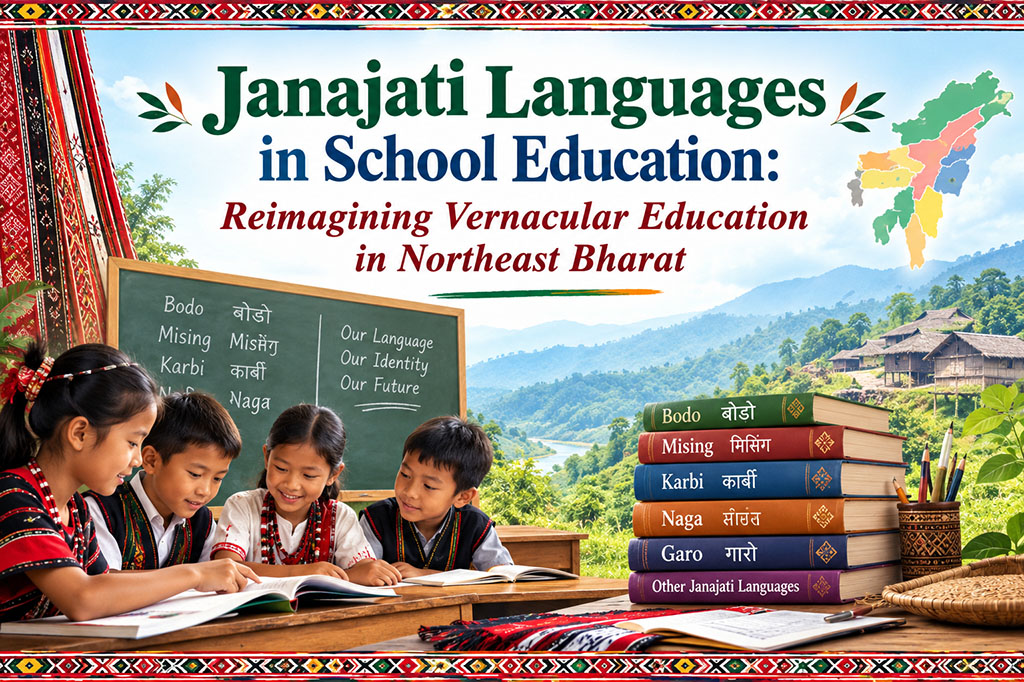
The analysis suggests that language-in-education policy in Northeast Bharat must be grounded in the principle of additive vernacular education, wherein linguistic expansion does not entail linguistic displacement.
Education should maintain continuity between home language and school language in early years while progressively introducing additional languages in a structured manner. At a broader sociological level, education should not function as an instrument of cultural substitution but as a mechanism of cultural continuity and epistemic expansion. The central objective is to ensure that Janajati languages remain living languages of knowledge, learning, and social life, rather than being confined to symbolic or restricted domains. Northeast Bharat is inherently multilingual, but its school system should adopt a stronger vernacular-centred educational approach.
Such an approach aligns with principles of linguistic justice and educational equity, recognising linguistic diversity not as a developmental constraint but as a foundational resource for cognitive, cultural, and social flourishing.
References
Berger, P. L., & Luckmann, T. (1966). The social construction of reality. Anchor Books.
Bourdieu, P. (1991). Language and symbolic power. Harvard University Press.
Cummins, J. (2000). Language, power and pedagogy. Multilingual Matters.
Fishman, J. A. (1991). Reversing language shift. Multilingual Matters.
Ingold, T. (2000). The perception of the environment. Routledge.
Ministry of Education, Government of India. (2020). National Education Policy 2020.
Sapir, E. (1921). Language: An introduction to the study of speech. Harcourt.
UNESCO. (2024). Global education monitoring report: Language and learning. UNESCO.
(The author of this article is an Assistant Professor, Centre for Study of Social Systems at Jawaharlal Nehru University. She can be reached at Phone-8011679149)