

By Dr. Jnanendra Barman
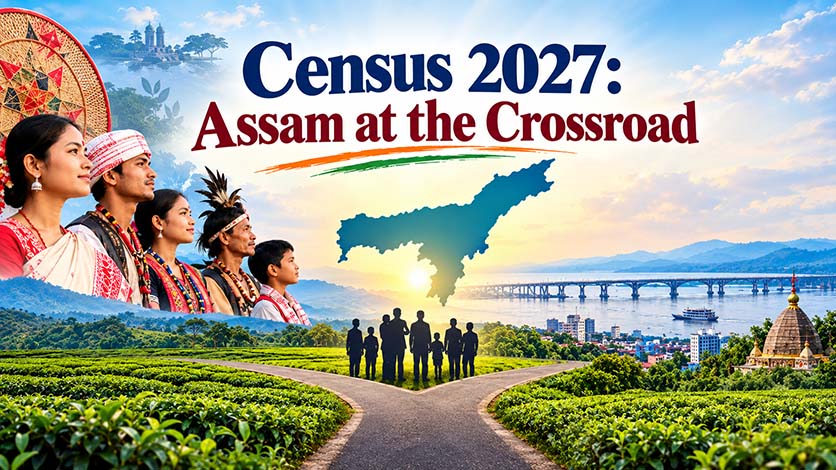
Some leaders and organisations in Assam have been working to develop a separatist identity for the Janajatis of Assam. Not only Janajatis, some groups, are even working to alienate one of the leading communities of Assam, the Ahoms from the Hindu stream. Meetings are being organised, social media platforms are being used to motivate the Janajati Hindus and the Ahoms not to registrar themselves as Hindus. This will work to put the Janajatis and a minority section of the Ahoms who don't want to registrar themselves as Hindus into the "Other Religions and Persuasions" category. The religious categories in the census include Hinduism, Islam, Christianity, Sikhism, Jainism, Buddhism and "Other Religions and Denominations" Now if a person from the Bodo community (the leading ST community of Assam) wants to write 'Bathou' in the religious section or an Ahom wants to write 'Furalung' in the religious category, it will be included in the "Other Religions and Persuasions " category and this will only help in reducing the percentage of Hindus in Assam.
Infiltration from across the border, disproportionate birth rate, child marriage, polygamy etc. have already led to disproportionate increase of Muslim population in Assam. In such a situation, if some of the janajatis or ethnic Hindu community deviates from the Hindu mainstream, it will work to accelerate the minorityization process of the Hindus in Assam. If Hindus become minority in Assam, the Islamist parties and organizations will gladly carry forward the dream of the Muslim League to turn Assam into an Islamic state.
The "Assam Backward Plains Tribal League", formed in 1933, urged the Janajati people to register themselves as non-Hindus in the 1941 census. Muslim League leader Sayed Shadullah's divisive Islamic scheme worked behind this call. Shadullah cleverly wanted to win over the janajati leadership in order to advance the Islamic scheme. "Shadullah advised the Janajati leaders not to register themselves as Hindus. Bhimbar Deuri considered Shadullah's advice reasonable. (Jatindra Kumar Bargohain, Axomor Sanskritic Itihas , p. 226).
The caste system that had become entrenched in Hindu society also helped to alienate the janajati community from the Hindu stream. The janajati community didn't want to be known as lower caste Hindus. In 1929, the Assam Kachari Youth Association submitted a memorandum to the Simon Commission opposing the inclusion of the Janajati as lower caste Hindus. In the 1941 census, a large proportion of the Janajati communities of Assam registered as non-Hindu. As a result the Hindu population in the state decreased by 17.7% from 34,07,831 in 1931 to 28,04,202 in 1941. In contrast, the Muslim population in the state increased by 38.2%. Later, Shadullah advocated for inclusion of Assam in Islamic Pakistan citing the data of 1941 census. Janajati leadership seems to have failed to realise the conspiracy of the Sadullah government.
On 31st January, 1941 Sadullah declared at the session of the Assam Pradesh Muslim League that "if Bengal and Assam can be converted into Muslim majority provinces, it would contribute to form a Muslim province in the North East In 1943." On 6th March, 1946 the Land Development Scheme was passed and lakhs of bighas of land of Assam was handed to immigrant Muslims. The Shadullah government actually implemented "Grow more Muslims" policy in the name of "Grow more Crops" scheme. Assam was filled with millions of immigrant Muslims; inner line system was abolished and even in janajati areas, immigrant Muslims were settled. "The influx of immigrant Muslims from Bengal to Assam during the seven year period from 1939 to 1946 was so strong that Jinnah demanded the inclusion of Assam in Pakistan during the partition of India. (Quoted from Satish Chandra Kakati's article "Lokpriya Bardoloir Oparat Gandhijir Prabhab" ). "Shadullah imported millions of Muslims from Rangpur and Maimansingh districts of Bengal at the instigation of the Muslim League.
As Gaurishankar Bhattacharya said, 'the Tribal League supported the Muslim League government formed on 17 November 1939, due to opportunism of some janajati leaders or due to Economic backwardness and other reasons. This made the political situation in Assam favorable to the Muslim League and the greater interest of Assam was at stake. One day before the 1946 general elections, Shadullah Sahib coincidentally confronted Gopinath Bardoloi; Sadullah said, "Gopi, how could you imagine the Congress would win the election? I have 34 Muslims, 9 Europeans, 5 laborers and 7 Janajatis in my hands..... "(Quoted from the article - "Lokpriya Bardoloir Bisokhyan Netritto" By Mahendra Mohan Chowdhury'). The Congress won the elections under the leadership of Gopinath Bardoloi. Bordoloi succeeded in bringing together all the castes and ethnic communities at a critical juncture in Assam's history.
The Muslim League was sponsored by the British, and Shadullah's argument to annex Assam to Bengal was supported by Secretary of India Sir Pathick Lawrence. Gopinath Bardoloi thwarted the conspiracy of the Muslim League and the British by winning the trust of the janajati leadership. Bardoloi was the leader who brought 'the Sixth Schedule' and 'Tribal Block and Belt' for protection of Janajati right and identity.
Some, oriented in Western hegemonic ideology, seek to separate the idol worshippers and Nature worshippers. They fail to understand that the Western concept of religious classification cannot be applied to India. The Merrian Webster Dictionary defines religion as "Relating to or manifesting faithful devotion to an acknowledged Ultimate reality or deity.
This definition does not take into account the Indian Sanatan tradition: the Sanatan tradition believes in pantheism. There are many sects and panths in Hindu society. British officials also faced considerable difficulties in defining "Hindu." In the 1911 census report, the British census officer stated that 'the Hindu word "dharma" which corresponds most clearly to our word "religion" connotes conduct more than creed"
"Realizing the complexity of defining Hindus as religions in the Western sense, the officials identified as Hindus those who were not Christians, Muslims and Parsis. Superintendent Ebston , officer in charge of the 1881 Punjab census recorded:
"Every native who was unable to define his creed or described it by any other name than that of some recognized religion or of a sect of some such religion, was held to be and classes as a Hindu".
Similarly, in the 1891 census report of Assam, Superintendent Gate wrote, "I know that, as a general rule, a native of India is looked on as a Hindu, if he does not definitely say that he is something else"
In the 1881 census, the British, at their own discretion, created a new religious category called "Hill Tribe":
"It should be explained that the term "Hill Tribes" has been used arbitrarily to designate certain non-Aryantribes which are more decidedly hostile to Hinduism than Others. and it will be seen that Abors, Daflas, Garos, Khasis, Santangs, Kukis, Mikirs, Miris, Mishimis and Nagas are included under the head; while manyother tribes which are classed as aboriginal such as Kacharis, Hajongs, Lalungs and others have been entered in the religion tables as Hindus" (The Assam Province Census Report, 1981)
Although British officials also acknowledged that there was no direct distinction between Hindus and these other tribes, they at their own will sowed the seeds of division by creating separate religious classes. Later, the term "Animism" was used instead of "Hill Tribe" and E. A. Gate called this category "inferior religion"
The missionaries were allowed to convert by calling janajati way of worshipping a "inferior religion" to serve colonial interests. From 1871 to 1891, the Christian population in Nagaland increased from 1895 to 14,762.
After independence, the Constituent Assembly and the leadership of the country were clear that the ethnic and religious divisions created by the British Divide and Rule policy should not be applied in independent India. It was intended to remove caste and religious categories from the census but religious categories could not be removed in view of the constitutional provisions and special rights for Scheduled Castes. According to the Constitution, if a person converts from Hinduism to another religion, he will not get the benefits available to Scheduled Castes. Therefore, it became necessary to register a person's religion. In the 1951 census, six main religious categories were created... Hindu, Muslim, Christian, Sikh, Buddhist and Jain. Jews, Parsies were combined to create a category-Other Religions and Persuasions (ORPs)
It is noteworthy that during the period 1951-2011, the country also saw a steady increase in the population of two categories: Muslims and Other Religions and Religious Followers (ORPs). The Muslim population increased by 45.20% and "Other religions and religions" increased by 53.49%. Initially, the ORPs was created to include parsi and Jews, but later it became more common for janajati communities. In the 2011 census, a total of 86 religions were included in the ORPs category as against 108 in 2001. The total population under ORPs category is 79,37,734: of which 89.39% are scheduled groups. This shows that ORPs is not a statistical category, it is a conspiracy to alienate the janajati community from other communities of Indian origin.
Geographically, janajati states have the highest number of people in the ORPs category: Arunachal Pradesh has 26.80%; 12.84% in Jharkhand. The growth rate in the ORPs category during 1991-2001 period is 103.09%. During this period ORPs increased by 1561% in Manipur 2747% in Chattishgarh, 4254% in Sikkim and 1223% in Madhya Pradesh. In Christian-dominated Meghalaya and Nagaland, however, ORPs have declined. In 1881, 98% of the Nagas were separated from the Indian Sanatan Samaj by including them in the "Hill Tribe" category and between 1901 and 1911, the Christian population of Nagaland increased by 34.3%. In 1951, the number of janajati religious people decreased by 59.75% and the Christian population increased by 45.36%. Today, more than 97% people are Christian in Nagaland. In 1951, the ORPs, classified population in Meghalaya was 58.13%; Christians made up 23.77% of the population. In 2011, this ORPs decreased to 8.7% and the Christian population increased by 74.59%.The data speaks loudly of a scheme: First separate, then convert.