

By Dr. Yutika Narzary
1. Introduction: Bagurumba, the traditional folk dance of Bodos, is a beautiful dance rooted deeply in nature. Bagurumba draws inspiration from the steady and cautious movements of the bird, the free and graceful flight of butterflies, the undulating hills and flowing rivers. The mega event Baguruma Dwhou, 2026 has once again propelled this traditional dance into national and international limelight. In a historic and visually spectacular performance, over 10,000 Bodo artists performed Bagurumba in Guwahati, an event witnessed by the Hon'ble Prime Minister of India, marking a significant step for the dance's global presence. Organised by the Assam Government to celebrate the rich cultural heritage of the Bodo community, the event featured the participation of more than 10,000 artistes from 81 assembly constituencies across 23 districts of the Assam. The artists from neighboring state West Bengal and neighboring country Nepal also participated in the event making it an international event. Beyond its sheer scale, the event marked a defining cultural moment by placing Bodo heritage firmly on the national stage, transforming Bagurumba from a regional folk tradition into a powerful symbol of indigenous identity, unity, and cultural pride with growing global resonance.
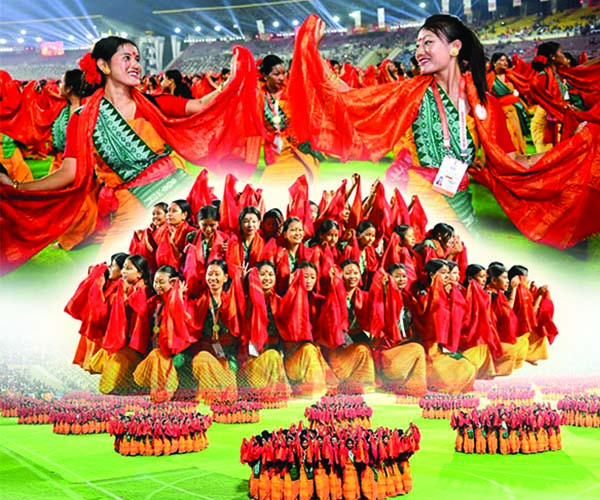
The event had been trending across social media platforms since the commencement of the practice sessions, steadily building anticipation and public engagement. The momentum reached its visual climax on the final day, 17 January 2026, when social media feeds were flooded with heartfelt and proud reactions from netizens across Assam. A historic record was created as 10,000 young girls, adorned in traditional red Jwmgra with Hajw agor or Rege-rega agor and yellow Maidi Dokhna with traditional designs, performed Bagurumba in perfect unison. The spectacle resembled a wave of red butterflies, and the performance was nothing short of surreal. It was a mesmerizing moment that gave the impression that the earth itself had chosen to blossom in celebration. The dancers were executing the traditional steps with poise and synchronization to the echoing rhythms of the Kham, Sifung, Jotha, Serja, and Thorkha.
Reacting to the grand spectacle, Prime Minister Narendra Modi wrote on X, "A spectacular Bagurumba dance performance in Guwahati!"[1]. Chief Minister of Assam Dr. Hemanta Biswa Sarma reacts on the viral trend of Bagurumba from Davos where he went for attending the 56th Annual World Economic Forum [2]. The Sunday Guardian [3] described the event as "Bagurumba Dwhou Marks Assam's New Socio-Cultural Evolution." The Pioneer[4] referred to Bagurumba as "a symbol of Bodo culture." WION noted that "Bagurumba is a traditional folk dance of the Bodo community, often referred to as the butterfly dance"[5]. One FB page has written "What looks unreal is actually a civilization."NDTV, in its coverage titled "Bagurumba: A Dance Dedicated to Nature,"[6] and many more media outlets also reported extensively on the event.
Existing literature and public media frequently describe Bagurumba as a folk dance performed during New Year festivals such as Bwisagu & Domasi. However, such festival-centric interpretations tend to overlook the deeper cultural meanings of this folk dance. The Bodos Kachar is constitute the largest ethnic group amongst the Tribes of Northeast India. The religion of Bodos is said to be "animistic" for they firmly believe that all objects possess a soul that cannot be decimated[7].There are several Bodo folk dances, each performed on specific social, ritual, or festive occasions. Dr. Liladhar Brahma in his book discussed about classification of Bodo Folk dances into five categories: Kherai, Bagurumba, Haba janai, Raijw janai, and Bwisagu mwsanai [8]. Kherai mwsanai is specifically associated with the Kherai puja of the Bathou religion, and is performed by the doudini in honor of the Bathou deities. Bwisagu mwsanai is similar to the Assamese Bihu dance and is performed to welcome the New Year in April. Dance forms such as Bwirathi mwsanai, Barlanfa mwsanai etc., are associated with marriage rituals, and are categorized under Haba janai mwsanai, while community-based dances such as Na-gurnai fall under Raijw janai mwsanai. Bagurumba is recognized as separate dance form and is regarded as one of the most graceful dances of the Bodos, traditionally associated with merrymaking, gossip, and communal bonding, performed exclusively by women [9].
2. A brief interpretation of derivation and narration of Bagurumba
A. Interpretation 1: According to oral tradition, Bagurumba has its origin in Thakhripharlla. In ancient Bodo society, all unmarried girls resided in a dormitory built either in the house of a person known for good character or in the residence of the Hadungwra (village head or gaubura). According to some sources, these dormitories were known as Thakhripharlla [8, 10, 11, and 12]. There is also a mention of male dormitory system in one literature[10].The male dormitories were constructed in the entry point of the village, which was platform architecture, constructed on tree top. The boys used to live there to guard the village and acquire different skills[10]. The female dormitories functioned as educational, social and cultural institutions where girls were trained in life skills, cooking, weaving, music, and dance [8, 11, 12, 14, and 15]. Only the girls who reached puberty could stay in Thakhripharlla, and the boys were strictly prohibited from entering girl's dormitory [15]. During the moments of leisure and social interaction, the girls in those dormitories danced by clapping hands and playing gongona (jew's harp). In its earlier form, Bagurumba was executed solely through hand clapping and thumping the body parts including posterior gluteal (thapli) and thigh regions, rhythmic playing of the Gongona, and the characteristic rumbling sounds of footwork (grwm-grwm) [14, 15].The contemporary form of Bagurumba has evolved through gradual transformation from these dormitories. Ostad Kamini Narzary and his contemporaries systematized the steps, making them more poised, organized, and disciplined. Other Bodo dances, including Bardwisila mwsanai, Thungri mwsanai, and Daosri delai, have similarly evolved over generations. In 1957, Bagurumba was presented in Republic Day Parade in New Delhi, in the presence of the first President of India Dr. Rajendra Prasad [12, 14, and 15]. The performance bagged prize, and recognition at the national level. The popularization of Bodo folk dance and music globally can largely be attributed to the tireless efforts of Ostad Kamini Narzary and his team [12, 14]. For his pioneering work and profound contribution to Bodo Folk culture, he received prestigious Sangeet Natak Academy Award in 1981. The concept of origin of Bagurumba from Thakripharlla or female dormitory has been mentioned in book titled "Boroni Mwsanai" by Dr. Liladhar Brahma, article published in Annual magazine of Bodo Sahitya Sabha authorted by Dr. Haricharancharan Narjinari in 2026, annual magazine by Dularai Boro Harimu Afad written by Mr. Benudhar Gayary in 2008 and in the doctoral research thesis of Dr. Hargouri Narzary (2018) titled "Myths in Bodo Society: A Folkloric Study' available in INFLIBNET.
B.Interpretation 2: Dr. Liladhar Brahma, in his book Boro Mwsanai also mentioned a second interpretation of Bagurumba, highlighting its spiritual significance, and provided anetymological definition, and similar view was reported by a research scholar of folklore studies from Gauhati University [8,9]. According to second interpretation, Bagaroumba (ckxksjkSEck) is composed of four syllables- Ba (ck), Iga (bxk*), Rou (jkS) and Ba (ck)-each carrying distinct semantic significance. The syllable Ba (ck) has multiple meanings in the Bodo language; in this context, it denotes "to carry a responsibility." Iga (bxk*) means "to come out" or "to emerge," while Rou (jk) refers to "heaven" or the "high abode of God." The final Ba (ck) signifies the number "five," which in Bathouism represents the five fundamental principles of life: Earth (Ha), Water (Dwi), Fire/Sun (Or/San), Air (Bar), and Sky or Ether (Okhrang)[8, 9]. Collectively, the term means the responsibility of dancers to bring Bwrai Bathou, the creator of the five elements of the universe, into the human world through the characteristic dance movement-baidemlai-sidemlai. Baidemlai denotes flexing movements, particularly involving gentle bending of the knees, waist, and limbs, symbolizing humility, groundedness, and the connection of the dancer with the earth. In contrast, Sidemlai refers to bending and flowing movements of the body and arms, creating a rhythmic, wave-like motion that reflects harmony with nature, such as the swaying of flowing water, or the fluttering of butterflies [8, 9, and 12]. However, due to gradual evolution of dance choreography over time, the sacred movements of rituals are no longer found in contemporary Bagurumba [8]. The ritual elements have diverged and the contemporary Bagurumba is recognized as a separate dance form [8]. However, during the interview with some informants it was found that some cultural thinkers do not agree with this interpretation that links Bagurumba with spiritualism and festivals like Bwisagu (Rongali Bihu) and Domasi(Mag Bihu)[12]. They opine that prayer rituals are performed through a separate dance form known as Kherai mwsanai, while the celebration of the Bodo New Year has its own distinct dance called Bwisagu mwsanai [12].Therefore, it is suggested that an informed understanding of Bagurumba requires more in-depth examination and research in future.
3. The Lyrics of Bodo folk song Bagurumba:
A. Bagurumba hai bagurumba
Jat nongabwla, khul nongabwla
Thabwrwm homnanwi
bamnanwi lagoumwn kha
Hai lwgw, lagou mwnkha
Translation and interpretation: Bagurmba can also be interpreted as ba meaning "landing" like the landing flight of bird which symbolizes grace, balance, harmony and nature.Gurum or gwrm is "thumping and rumbling sound of rhythmic vibration produced by collective dancing". Jat khul means "clan and family".
The stanza "jat nongabla …. lagoumwn kha" translates as: "If you weren't from my clan and family, I would have held him in my embrace and carry him away." This captures a universal human feeling of attraction between young people and acknowledging it by respecting culturing boundaries. This represents a playful expression of young women for her romantic interest within socially accepted norms. Choreographically, the starting dance movements mimic footwork of the slow, steady and poised movements of a dove and the hand movement with jwmgra mimics the flapping butterflies.
B. Thuri bari ni lai daosen
Jwngni lagw aalai da jen
Gwsw hwsar hwsar mwsa de
Bagurum bagurummwsa de
Translation: Here Thuri is "thatch grass (Imperata cylindrical)", and dowsen is "warbler (Phylloscopus sp.)", a small bird habiting in the ecosystem of the thatch grass. Jwngni is "our" lagw is "village", da jen is "do not face defeat", Gwsw hwsar hwsar is to give "heart and soul."
The line translates as: Dowsen (warbler bird) of grassland (thatch grass),
May our village not face defeat,
Give your heart and soul and dance.
Interpretation: The bird dowsen is a small bird inhabiting the ecosystem of tall thatch grasses. They can overcome all the odds and challenges of their environment because they are united. Through this metaphor, young women describe themselves and their community as birds dwelling among tall grasses. Just like dowsen birds stay united to face the challenges of the life. Our village and community will also thrive and will never face a defeat. Similar interpretation was mention by Dr. Hiracharan Narzary [14] in the annual magazine published by Bodo Sahitya Sabha, 2026. These lines of the song usemetaphor from the natural environment to express the identity of the community, and endurance. This may also symbolize the vulnerability of womenfolk, yet asserting resilience and uncompromising spirit that resist defeat. The use of thuri is common in many bswisagu songs and even in Bodo proverbs [13]. The repeated reference of this grass is not merely ornamental, but carries ecological significance. Thuri grass typically grows near river banks and wetlands, and its presence in song reflects the Bodo community's ecological knowledge as well as historical preference in settlement near the wetlands and rivers for agriculture and sustenance.
C. Bagurumba hai bagurumba
Bagurumba hai bagurumba
Dwi jiri jiri,samo khingkhiri
Sona ni jinjiri,hai jinjiri , hai jinjiri
Translation and interpretation: Dwi jiri is "gentle, continuous flow or rippling sound of water flowing over riverbeds". Samo khingkhiri is fresh water snails (Brotia costula), and Sonani jinjiri is golden chain. The "continuous river flow", the "samo khingkhiri whose nature is to lie arranged in line on river beds" and the "chain of gold" are used as metaphor and depicted in the choreography. In the choreography, the movements imitate the natural elements and dancers visually and rhythmically form a continuous, circular or chain-like formation that evokes flowing water, spiral arrangement of snails and golden chain. Dr. Hiracharan Narjinary interprets the metaphors of "snails" and "gold chains" as symbolic representation of collective effort of the community to achieve the goal or victory. He states, "As the snails in water move in groups so also the Bodos should move in groups, in unision. At length you would achieve the goal in getting the gold chain" [14].
4. Dress and Instruments used in Bagurumba: The traditional attire worn during the Bagurumba dance consists of Dokhna, Jwmgra, and Aronai. The Dokhna is draped from the chest and covers the entire length of the body up to the feet, distinguished by its unique wrapping style. The traditional Maidi Dokhna, predominantly yellow in colour, is commonly used during Bagurumba performances [8]. Jwmgra is another component of Bodo dress, used to cover the upper part of the body. A red-coloured Jwmgra with "hajw agor"or "rege rega agor", a form of design with the outline of hills and flowers are used in Bagurumba performance [11, 8, 13, and 15]. The design patterns of traditional garments Jwmgra and Dokhna represent natural elements like landscape hills, flora and fauna of the locality e.g. eyes of dove (pharow megon), fern (dinkhila agor), baigri bibar agor (floers of jujube) etc. Aronai, a culturally significant traditional muffler, is draped across the shoulder, with additional piece tied around the waist. The hair is tied in a particular way called "khislang khanai". "Phulkhuri & makhri sona" earrings, necklace called "Chandrahalaa", bangles "gothaaasan" are adorned during Bagurumba [8,11,13,15]. The instruments used are Sifung (flute), Kham (Large, barrel shaped, double sided wooden drum), Serja (String instrument), Jotha (Cymbal), and Thorkha and Jabkhring [15]. All the instruments form an integral part of the rich cultural heritage and legacy of the Bodo community, each carrying with it associated lores, myths, and tales.
5. Conclusion: Bagurumba is the emotion and cultural identity of Bodo community. Bagurumba is considered as the queen of all the Bodo folk dance forms because of the beautiful choreography imitating natural elements like birds, butterflies etc. Its rhythm is balanced, beginning with a slow pace before gradually intensifying, and again slowing down, much like the rhythmic rise and fall of waves. Bagurumba is grounded, poised, and harmoniously structured, reflecting aesthetic restraint and cultural refinement. Bagurumba is predominantly performed by women, and it highlights the central role of Bodo women in preserving and transmitting cultural knowledge. Women's participation reinforces gendered expressions of beauty, creativity, and social belonging, while positioning them as custodians of tradition and ecological wisdom. The quote, "What looks unreal is actually a civilization," aptly captures the essence of Bagurumba. Far from being merely a visual spectacle, Bagurumba narrates the civilizational journey of the Bodo community. The Bodo community has endured historical processes of annexation and marginalization, yet has remained resilient, continuing to survive, adapt, and thrive through cultural perseverance and collective strength. Collectively, Bagurumba functions as a powerful cultural emblem that encapsulates the Bodo community's cultural heritage, traditional knowledge, and aesthetic sensibilities. q
Acknowledgement: My sincere gratitude to all the informants for sharing their knowledge and perspective on Bagurumba. Special thanks to the faculties of Bodo Department, Bodoland University, Mr. Swmdwn Narzary (B.B. Engineering College), and Mr. Karajit Brahma for their help in finding relevant literatures for writing the article.
References:
[1] Indian Embassy US. 2026. Post on Bagurumba dance. X (formerly Twitter).January 19, 2026.
[2] Northeast Live TV. 2026. Facebook video post on international recognition of Bagurumba.January 22, 2026.
[3] The Sunday Guardian. 2026. "Bagurumba Dwhou Marks Assam's New Socio-Cultural Evolution." January 19, 2026.
[4] The Pioneer. 2026. "Bagurumba: A Symbol of Bodo Culture, Says Himanta."January 19, 2026.
[5] WION. 2026. "'A Spectacular Performance': PM Modi Shares Glimpses of Bagurumba Dance During His Two-Day Assam Visit." WION News. January 19, 2026.
[6] NDTV. 2026. "PM Modi to Witness 10,000 Bodo Dancers Perform Bagurumba During Assam Visit." January 19, 2026.
[7] Endle, Sidney. 1911. The Kacharis. London: Macmillan and Co., Limited. (Online edition consulted).
[8] Brahma, Liladhar. 2011. Boro Mwsanai. Assam Institute of Research for Tribals and Scheduled Castes.Jawahar Nagar, Guwahati.
[9] Boro, C. 2025. "Bagurumba Dance of the Bodo Tribe: Its Cultural Identity, Transformation and Continuity." International Journal of Novel Research and Development 10(11): a246.
[10] Deka, Nabajit. 2018. Vernacular Architecture of Assam with Special Reference to the Brahmaputra Valley. PhD thesis, Department of Folklore, Gauhati University, Assam. Chapter 8.
[11] Narzary, Hargouri. 2018. Myths in Bodo Society: A Folkloric Study. PhD thesis, Centre for Cultural & Creative Studies, North-Eastern Hill University, Shillong, pp. 1-29.
[12] Informants. 2026. Field interviews with Informants 1-10, Kokrajhar, Baksa and Chirang districts, Assam.
[13] Boro, Anil Kumar. 2014. Folk Literature of the Bodos. 3rd ed. Panbazar, Guwahati: N. L. Publications.
[14] Narjinai, Hira Charan. 2026. "Ostad Kamini Kumar Narzary: The Morning Star of Traditional Bodo Dance and Music." The Bodo, 54th issue. Published by Bodo Sahitya Sabha.
[15] Gayary, Benudhar. 2008. "Bagurumba Mwsamu." Harimu Magazine, edited by Basumutary D., pp. 22-25. Chapaguri, Chirang: Dularai Boro Harimu Afad