

By Pranab Phukan
Introduction: We all must have been immensely pleased to see something special shown in the tableau of Assam in the 77th Republic Day Parade in the Kartavya Path of New Delhi. Shown here was a glimpse of terracotta of Asharikandi Village in Dhubri District. Surely it will take this village and this art form to the world. But how many of us are aware of this art form of this village? Today I am trying to touch upon this subject.
Terracotta: Let us know at first what is terracotta? Terracotta is form of objects made of clay. This leads us to the sight of the omnipresent potter’s wheel wherein the potters put a bit of clay, turn the wheel, and use their hands to give shape of items of daily use, like pitchers, pots, plates as well as some decorative items and a few dolls for children.
Hiramati: What is so special about Asharikandi terracotta? In the adjoining areas of this village a special type of clay called Hiramati is available. Items made of this clay are not as brittle as other pottery items and are more attractive to look at. We keep seeing items dug up from the sites of ancient civilisation wherein many terracotta items are found intact even after so many centuries. So, it is understandable why hiramati and terracotta are special to the artisans.
A question arises: what is hiramati? Is it different from the clay used by other potters? Hiramati is sticky clay. A little bit of sand is mixed with this clay. Clay used by potters is also sticky, but no sand is mixed with it. Because of mixing of sand, the clay changes its properties.
Use of hiramati: For the terracotta art form and cottage industry hiramati is very essential. The artisans make all their items using hiramati only.
Properties of hiramati: As hiramati is like a very sticky paste, so it becomes easier to give shape to different items with it. Moreover, due to this property items made of hiramati have more strength, better finish and have better stability.
Difference between the processes of hiramati and potter’s clay: Potters use a special wheel for production of their items. A little clay is put in the top middle portion of the wheel which is then set into motion and with their hands give shape to the product intended. But the artisans of Asharikandi do not use any such wheel; with the clay mixed with sand the products are given shape only merely with their hands. These are then dried in the sun and then put into fire. This process gives strength to the products and are stabler than potters’ products.
Location of Asharikandi: Asharikandi is a village in Debitola Development Block of Dhubri District in Assam. It is situated on the banks of River Gadadhar, a tributary of River Brahmaputra which is also quite nearby. So the terracotta artisans find it easy to navigate the rivers for selling their produce. Moreover, land transport is available from Gauripur and Dhubri. The distance to Dhubri is 14 km; nearest railway station at Gauripur is 8km away. Nearest airport at Rupsi, Dhubri is also 14km away. There are daily buses between Dhubri and Gauripur. Most people from this village are employed in terracotta art and craft from many generations.
Origin of the name Asharikandi: As per local folklore, the name is a combination of two words, Ashar and kandi. Ahar is the third month of the year as per Assamese calendar; Ashar is the name of this month in the local dialect, Goalporia. Kandi means to cry or weep. Torrential rain sweeps Assam in this month. It looks like as if the weather is also crying. So, there is a possibility that this is the reason for the name, Asharikandi. However, local folklore says that due to rain, and consequent floods, the people here can neither dry nor store their produce. Even the items dried or burnt earlier get wasted. Hence it is natural that they cry and the name took birth.
Terracotta art of Asharikandi: At the beginning of 19th Century, a few families from East Bengal (present day Bangladesh) migrated to Asharikandi. They are Bengali speaking people of the Paul community. Pauls are traditionally doing pottery work. Due to abundance of hiramati and ease of water transport, they settled down here and continued pottery and terracotta work to earn their living. They also brought some innovations to their art. Thus, special terracotta art and craft form of Assam was born. Even today most of the families are gainfully engaged in pottery and terracotta. With growing interest in and demand for terracotta art and craft in the national and international markets, livelihood of the artisans have become easier. Today terracotta art and craft of Dhubri District has is universally recognised.
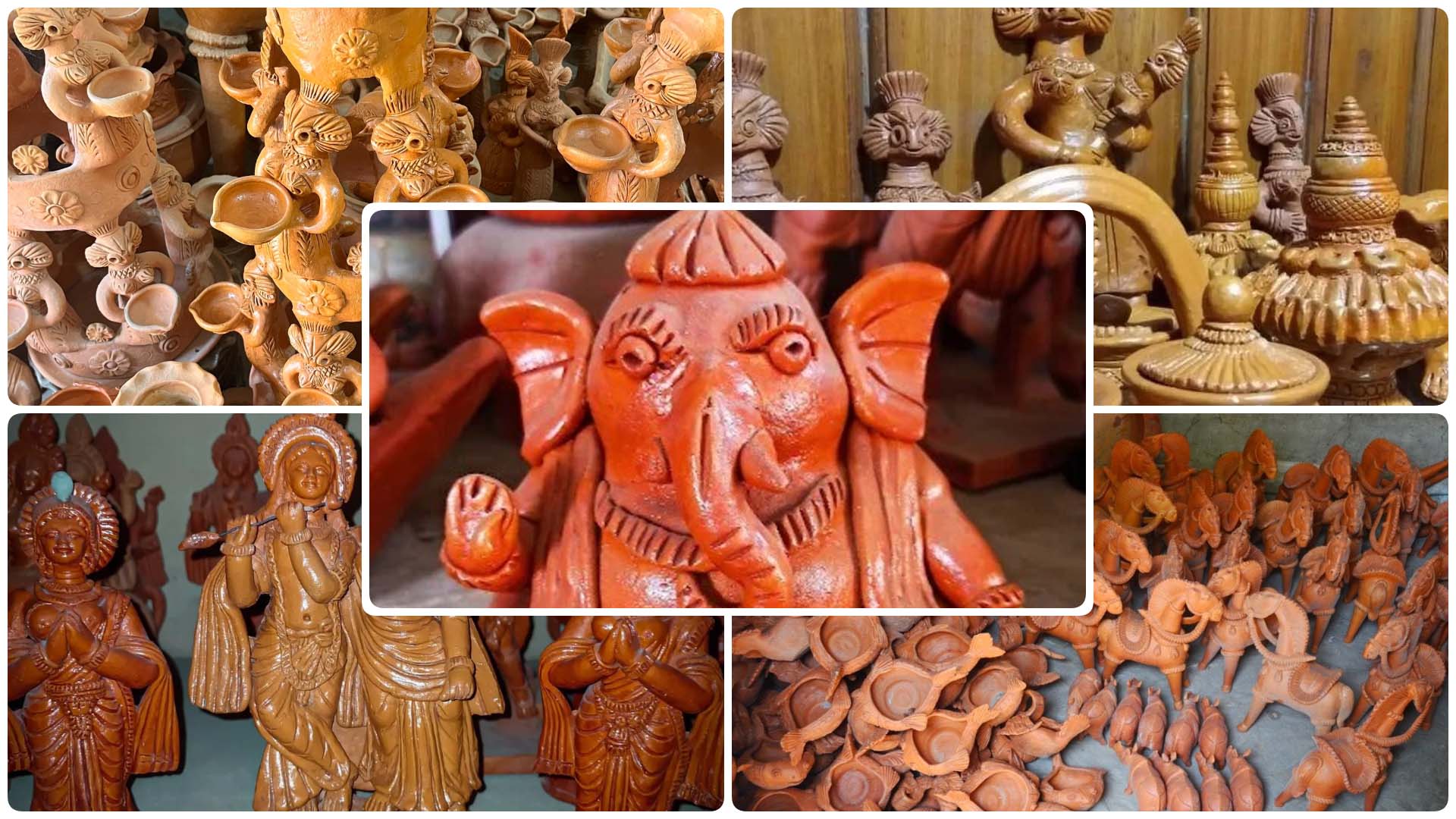
Well known artisans: Amongst so many artisans of Asharikandi, special mention should be made of Late Sarala Bala Devi. She was honoured with National Award for Pottery and Terracotta in 1982. A doll made by her of a mother with her child in her arms brought recognition to this art form. This doll is known as the Hatima Doll. Her son Dhirendra Nath Paul is a nationally and internationally renowned master of the art form. Shri Mahadeb Paul was honoured with State Pottery and Terracotta Award for his famous doll of Lord Ganesh. There are many other talented artisans in this village.
Measures taken for development of Asharikandi Terracotta art and the artisans: North East Craft and Rural Development Organisation, (NECARDO), an NGO is implementing a programme under United Nations Development Programme (UNDP). The said NGO is working here since 2006 to implement the programme and aims to conserve the terracotta culture, develop it and uplift the socio-economic status of the artisans. Seeing the potential for rural tourism, The Government of Assam has declared this village as a model one and has brought it under Rural Tourism Programme. In 2020 while speaking about “Vocal for Local” and “Atmanirbhar Bharat” in his “Maan ki Baat” programme broadcast by Akashvani, our Prime Minister Shri Narendra Modi mentioned about Asharikandi Terracotta Art and Craft. NECARDO has declared Asharikandi to be one of the biggest terracotta clusters of the country.
Under the aforesaid programme, the Deputy Commissioner of Dhubri District has submitted a report titled “Rural Tourism Project on Terracotta craft cluster of Asharikandi in Dhubri District, Assam”. Accordingly; this village has been brought under the tourist circle of Assam. Due to development of infrastructure to attract tourists, the village is now being visited by many tourists. They can roam around the entire village and buy products of their choice. Hence Asharikandi Terracotta has gained wide publicity and is receiving worldwide recognition. This has made life easier for the artisans.
Another organisation working for the terracotta art and artists of Asharikandi is ATAPDC – Asharikandi Terracotta and Pottery Development Committee, which is a voluntary organization. This committee includes heads of district-level development departments and elected members of the Panchayat. This committee was formed by the Dhubri district administration, and the Deputy Commissioner of the district serves as its Chairperson.
One more organisation is ATDMSS Ltd. – Asharikandi Terracotta Doll Making Samabay Samiti Ltd. To support the terracotta artists, the Small Industries Development Bank of India (SIDBI) has constructed an office and warehouse. The building constructed by the District Rural Development Agency (DRDA) is currently being used for preserving handcrafted products. As a result, during the lean months, artist’s no longer have to struggle as badly as before. The Handicrafts Department of the Government of India, Assam Tourism Development Corporation, State Bank of India, and others are also actively working to meet the needs of the terracotta artisans of Asharikandi.
Benefits of the development projects: Earlier, artisans of Asharikandi had to travel from village to village and from fair to fair to sell their clay and terracotta products such as Hatima Doll, Ainar Ghora (terracotta horses decorated with small mirrors), elephants, rhinos, etc. But because of these development projects, many traders now purchase these products directly from the village. Fishermen from the Barman community of Asharikandi village also help in selling these products. Due to the hardships in the fishing profession, some of them are now engaged in terracotta production.
Conclusion: Proper implementation of the development projects undertaken will certainly help in the promotion and expansion of Asharikandi terracotta art and craft. As and when the funds allocated by the government are spent in phases for the development of Asharikandi terracotta art and craft and for the artisans, the terracotta art and craft of Asharikandi will flourish, and instead of tears during the difficult months, smiles will appear on the faces of the artisans.