

By Lemya Konyak
Aoleang-Mo-Nyu, the "festival of spring" or "Spring Festival," is the most cherished festival of the Konyak Naga Community of Nagaland. Festivals are typically held to commemorate significant religious events, often accompanied by distinct social activities, food, or ceremonies, according to the Cambridge dictionary. The Konyak Naga community, also known as the people of the "Land of the Ahng," resides in the eastern part of Nagaland, particularly in the Mon district, sharing its borders with Arunachal Pradesh to the north, Assam to the west, Myanmar to the east, the Longleng district to the southwest, and the Tuensang district to the south.
The Aoleang-Mo-Nyu is celebrated after the completion of sowing crops in the field and the construction of the field hut of the Ahng (King) in a traditional architectural style. This festival has a rich cultural heritage and great significance to the Konyak Naga people, Aoleang-Mo-Nyu is one of the oldest as it dates back to the time of their earliest ancestors, making it as old as the Konyak society itself. The festival is celebrated every year during the best time of the year, which is during the fresh and green season of spring.
Before the 1960s, Aoleang-Mo-Nyu used to be celebrated and observed on various days and months of the year by different areas, regions, or villages. It was only after the 1960s that the Konyak Students' Union, one of the apex organizations of the Konyak community, decided to establish uniform days and months to celebrate and observe the festival of the Konyak Naga. As a result, the Aoleang-Mo-Nyu is now celebrated and observed from 1st to 6th April of each year.
Aoleang-Mo-Nyu in the Past:
Before the advent of Christianity, Aoleang-Mo-Nyu was celebrated and observed in a distinctive manner, primarily involving the worship of bountiful gods or spirits. Of all the festivals celebrated and observed by the Konyak Naga in the past, Aoleang-Mo-Nyu held the greatest significance. The festival also marked the end of a successful year and welcomes the New Year with Great War achievements, as well as the joyous beginning of a new one.
The entire village would prepare for the festival with great enthusiasm for fifteen to twenty days before the festival. Before the arrival of spring, the villagers would work diligently to complete all their tasks so that they could devote more time to the celebration. They believed that nothing was more important than Aoleang-Mo-Nyu, and thus considered it worthy of sacrifice.
On the day preceding the festival, villagers, particularly the peer groups of different age groups known as "Ei.", would venture into the forest or jungle to collect wild jungle leaves called "Laie", banana stems known as "ngag", and other wild edible greens for the festival's feast.
The peer groups, known as "Shela," from each "baan" (Morung) would construct a wooden and bamboo dance platform in front of each Morung. Each Morung would select a healthy, tall, and the best bamboo to host it as a flag post known as "Keiphong." This Keiphong would then be decorated with young palm leaves known as "log yak." On the first day of the festival, especially in the morning, this post would be hoisted in one corner of the dance platform. The hoisting of the Keiphong is significant because it seeks the blessing of the "bountiful spirit" to bless the field or paddy, similar to this healthy, tall and the best bamboo, essentially serving as a symbol of offering.
The Aoleang-Mo-Nyu festival: The six-day festival of Aoleang-Mo-Nyu has a unique significance attributed to each day, and it is celebrated with much enthusiasm and fervour in the villages of Konyak Naga.
The first day, known as "Mon-Ak-SheakNyih" or "Ei-Moh-Nyih," is dedicated to the young men and women of the same age group called "ei" from the villages to slaughter the animals they have bought with their hard-earned money. This day is not observed by the entire village, but only by the young men and women. The rest of the villagers can go out to jungle or field to collect the necessities for the feast, as mentioned earlier. After the "ei-moh," the beating of the Aoleang log drum begins and with this marked the beginning of the celebration. Then festival begins in full swing.
The second day, known as "Ak-sheak-Nyih," is when the entire village slaughters the animals they have kept for the festival. Families who cannot afford to slaughter an animal for themselves can gather and share one animal within themselves. Sharing, exchanging of meat, rice, rice beer, and gifts in terms of ornaments are done during the festival on this day. Family members remember their deceased loved ones and pay their respects by going to the graveyard and cleaning the surroundings. They have their meals close to the grave and say, "We are having Aoleang-Mo-Nyu, we are giving you your share of meat, drink, rice, and rice beer," and then place the food near the grave. They later put the food into a basket hanging near the grave.
On the third day, families invite their married daughters and give them the best service as a token of their appreciation. They serve the best rice, meat, rice beer, and sticky rice. A special folk dance is performed called "Noalinbu" (Konkeitbu), which is particularly performed by men and has to be performed in a zig-zag line. This day is particularly set aside for the daughters who are married; it is a day of honouring them.
The fourth day, known as "Leang-Nyu-Nyih," is the main day of the festival. Men in full traditional attire perform a great dance called "Boa Shin aleibu," which is perform in celebration of the head hunted that year during the head-hunting years. Women folk serve rice beer, betel nut, and other refreshments to the dancers. Towards sunset or at night, women folk join the men folk of different morungs on the platforms and perform a folk dance and this dance performance (Boa Shin aleibu) is done only in those years when the head of an enemy is brought. The day ends with great merry-making, exchange of food, drink, and dance competition among the different morungs at the Ahng's campus (King's Campus).
On the fifth day, known as "Yin-Yan-Nyih" or "Wan-Shan-Nyih," the guests who came to celebrate the festival depart from the village. They leave the village carrying meat and sticky rice they received as a token of appreciation. It is known as a day to leave the village for those who come for the celebration of the festival or in case of any invitees are present in the village.
The final day of the festival, the sixth day, is when the villagers perform a final ritual of the festival. This ritual was performed in the field where six pairs of leaves are fastened to six outer posts of the hut, and two pairs of leaves to the two inner main posts. This particular ritual is performed for millet. Another ritual is performed where a mixture of pig's blood and rice flour is sprinkled while saying, "Seeds give good crops, excellent rice, and much taro (yam)." With these words and festivity, the year is sent off, and the new year is welcomed with much hope and great expectations that the year ahead will be the most promising one.
However, with the coming of Christianity, the Aoleang-Mo-Nyu of today is celebrated differently, although the name of the festival remains the same. The festival is still celebrated, but some of the rituals and traditions have changed.
Aoleang-Mo-Nyu Today:
In the present day, the ritual and performance of each day of Aoleang-Mo-Nyu is not observed as it was in the past among the Konyak Naga community. The old practices of the festival have been left behind with the acceptance of Christianity, which has brought many changes. The old practices of the Aoleang-Mo-Nyu were considered to be profane and not in alignment with Christian beliefs. Therefore, the festival is still celebrated from 1st April to 6th April, but the days are not strictly followed as they were before and no rituals are performed.
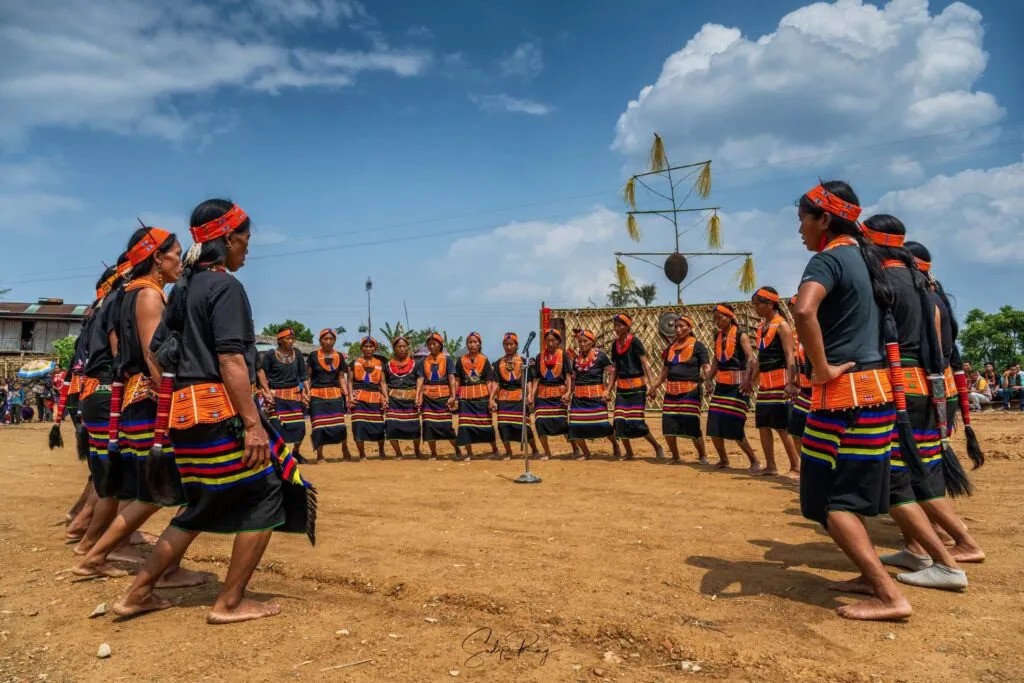
Today, the celebration has taken a different route, where each village sets aside one day within the 1-6 April periods to commemorate the festival. The village council, in collaboration with the church and students’ body, organizes a very decent program to celebrate the festival. A feast of Aoleang-Mo-Nyu is organized, and folk songs and dances are performed with full traditional attire. The songs and dances are now all fusion, giving praises to God and asking for protection for the year ahead. The past practices of Aoleang-Mo-Nyu did not continue till today for the good of humanity or the Konyak community as a whole. Instead, the festival serves as a time of reflection and renewal for the Konyak people. They gather together with family and friends, taking time to remember their heritage and culture, and reaffirming their commitment to living a life of faith and obedience to God.
For many Konyak Christians, the festival is an opportunity to share their faith with others. They may invite non-Christian friends and neighbours to join in the celebrations and use the occasion to share the good news of Jesus Christ. Today, the festival of Aoleang-Mo-Nyu is mostly centredaround God and Christian activities, and the elaborate practices have reduced it to a one-day event.
Although the celebration and observation of the festival have changed for better or worse, it is essential to let the younger generation know how and why the festival was celebrated. It is the right of the younger generation to know their roots, not to go back and start doing the ritual again, but to understand the culture and the root from which they come. Documentation is necessary so that the community knows the root from where they have sprung up to be. Just knowing the branches of the culture will lead to uprooting it.
In a random interview with the youth of the Konyak Naga, especially those from the urban centres, it was found that many of them were unaware of the real reason, ritual, and procedure of the festival. Some were aware that the festival was related to sowing and marking the New Year, but not all the details of the festival and its related aspects. Festival is a part of the precious culture, and knowing about it is the right of the younger generation. Even if they do not go back to the past, they can let their culture stay alive and live on in the hearts of the community by knowing the root, origin, significance, and importance of the festival.
It is also crucial for the younger generation to know how their community has moved on with their lives, their roots, and how they have drifted out to become who they are today.
(The author of this article is serving as an Assistant Professor in the Dept. of Sociology, Tetso College, Sovima, Nagaland)